Peek vs Peak Meaning: Definitions, Examples and Usage
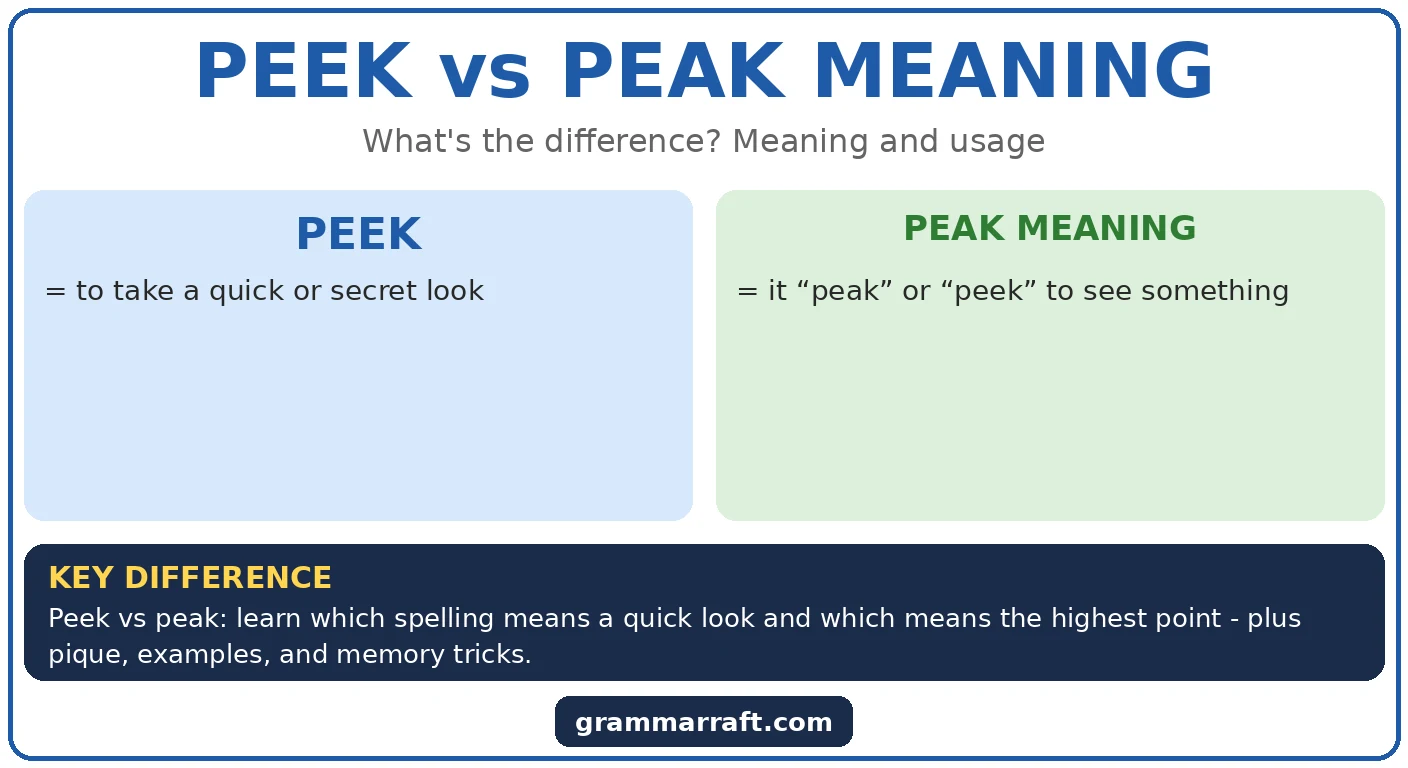
The difference between peek and peak is simple once you connect each spelling to its meaning. The phrase “peek vs peak meaning” usually points to two commonly confused words: one describes a quick look, while the other refers to a highest point, summit, or maximum level.
These words sound alike in standard English, but they cannot be used interchangeably in writing. A sentence about seeing something briefly needs peek; a sentence about the highest mountain or strongest performance needs peak.
You’ll also learn how pique fits into the comparison, why “peek out” is correct, how to remember the spellings, and which common phrases use each word. A few precise examples can make the distinction stick.
Peek vs Peak Meaning at a Glance
Peek means to take a quick or secret look. It can function as a verb, as in “She peeked through the doorway,” or as a noun, as in “He took a peek at the answer.” The central idea is brief or hidden looking.
Peak means the highest point of something. It can describe a physical summit, such as the peak of a mountain, or a maximum level, such as the peak of a career, season, or wave. It can also work as a verb and adjective.
| Word | Primary meaning | Typical grammatical use | Example |
|---|---|---|---|
| peek | A quick or secret look | Verb or noun | “Take a peek inside.” |
| peak | The highest point or greatest level | Noun, verb, or adjective | “Sales reached a peak.” |
| pique | To stimulate interest or curiosity | Verb; also part of the noun phrase “pique” | “The title piqued her interest.” |
A useful shortcut is to associate the double ee in peek with eyes. The letters do not literally spell “see,” but they can remind you that peek involves looking. For peak, picture the pointed top of a mountain.
In a phrase such as “a sneak peek,” the word means an early or limited look at something. In “at the peak of summer,” it means the period when summer is at its strongest or most developed.
What Does Peek Mean?
Peek describes looking quickly, briefly, secretly, or through a small opening. The action often suggests that the look is limited rather than complete. Someone may peek through a curtain, peek inside a box, or peek at a phone notification.
As a verb, peek can appear in several forms: peek, peeks, peeked, and peeking. The past-tense sentence “The child peeked under the bed” describes a completed glance, while “She is peeking around the corner” describes an action happening now.
As a noun, peek usually follows an article or another determiner. Common patterns include “a peek,” “another peek,” “one quick peek,” and “a sneak peek.” The noun refers to the look itself rather than the person doing the looking.
Common Uses of Peek

- Peek at: use this for a brief look at a particular object or subject, as in “I peeked at the schedule.”
- Peek into: use this for looking inside a place, container, or situation, as in “She peeked into the room.”
- Peek through: use this when something creates an opening or barrier, as in “Light peeked through the curtains.”
- Peek out: use this when someone or something appears partly from behind or inside another thing, as in “The cat peeked out from under the sofa.”
- Sneak peek: use this for a preview offered before a full release, event, or presentation.
The expression “peek out” is especially useful because people sometimes replace it with the incorrect phrase “peak out.” A person can peek out of a window, peek out from behind a wall, or peek out of a hiding place. The intended action is looking, so peek is the correct spelling.
Peek does not necessarily mean that the look is forbidden. A child may peek at a birthday gift because it is secret, but a customer may also peek inside a shop window without breaking any rule. The defining feature is the short or partial look.
What Does Peak Mean?
Peak refers to a top, summit, maximum, or highest level. The most concrete use is geographical: a mountain peak is its pointed or elevated top. The word can also describe the highest point of a graph, the busiest time of a day, or the strongest stage of a person’s career.
As a noun, peak appears in phrases such as “the mountain’s peak,” “the peak of the roof,” and “the peak of the season.” These examples all involve a top position or a period of maximum intensity.
As a verb, peak means to reach the highest level and then often stop rising. For example, “Demand peaked in July” means demand reached its maximum during July. The verb does not always imply an immediate decline, but it identifies the point at which growth or intensity was greatest.
Peak as an Adjective
Peak can also modify a noun. “Peak hours” are the busiest or most heavily used hours, while “peak season” is the period of greatest demand or activity. A travel company might describe summer as its peak season, and a transit authority might warn passengers about peak commuting hours.
The phrase “at its peak” means “at its highest level or strongest point.” A sentence such as “The athlete was at her peak in her late twenties” describes performance, not physical height. Similarly, “The storm reached peak intensity” identifies the maximum strength of the storm.
Some uses are metaphorical, but the basic image remains the same: imagine a line rising to a top point. That image works for mountains, sales, excitement, popularity, temperature, performance, and many other measurable or observable conditions.
People sometimes write “peak” when they mean a quick look because the two words are homophones. Context usually reveals the error, but readers may still pause or misunderstand the sentence. If the subject is seeing, choose peek; if the subject is reaching a top level, choose peak.
Peek, Peak and Pique Compared
The third word in this group is pique. It sounds like peek and peak, but its meaning is different. As a verb, pique means to stimulate interest, curiosity, or attention.
The most familiar expression is “pique someone’s interest.” If a strange headline makes you want to learn more, it has piqued your interest. The sentence is not about taking a look, and it is not about reaching a highest point.
For example, “The unusual photograph piqued my interest” means the photograph made me curious. “The unusual photograph peeked my interest” is incorrect because peek describes looking, not causing curiosity.
| Expression | Correct word | Meaning | Example |
|---|---|---|---|
| A quick look | peek | A brief glance | “I took a quick peek.” |
| The highest point | peak | A summit or maximum | “The trail reaches its peak.” |
| Stimulate curiosity | pique | Create interest | “The mystery piqued his interest.” |
| Make someone angry | pique | Offend or irritate someone’s pride | “The criticism piqued her pride.” |
Pique also appears in the noun phrase “in a fit of pique,” meaning in a state of wounded pride or irritation. That meaning is less common in everyday writing than “pique someone’s interest,” but it explains why the word can relate to annoyance as well as curiosity.
A quick editing test helps: if the sentence could be rewritten with “interest” or “curiosity,” use pique. If it could be rewritten with “look,” use peek. If it could be rewritten with “highest point,” use peak.
Pronunciation, Spelling and Grammar
In most varieties of English, peek, peak, and pique are pronounced alike: they rhyme with “week” and “leak.” Their pronunciation does not help listeners identify the intended word, so spelling and context carry the meaning in writing.
These words are homophones, which are words that sound the same but have different meanings and spellings. Homophones create particular problems in proofreading because a spellchecker may accept the wrong word as correctly spelled. A sentence can contain a real English word and still use that word incorrectly.
Grammar provides another useful clue. Peek can be a noun or a verb: “a peek” is a glance, and “to peek” is to look briefly. Peak can be a noun, verb, or adjective: “the peak,” “sales peaked,” and “peak demand” use the same spelling in different grammatical roles.
Inflected Forms
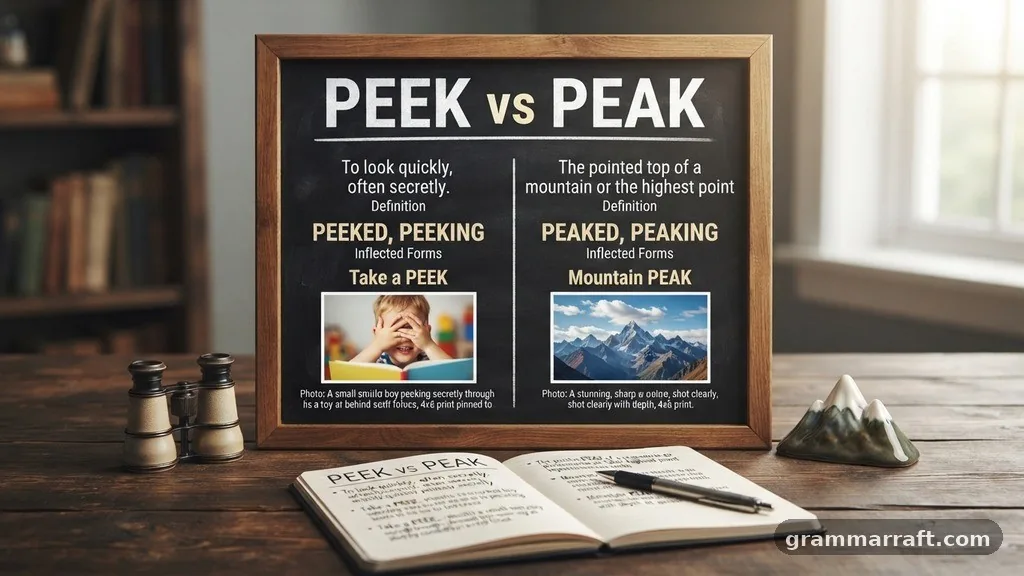
The forms of peek are regular: “peeked” and “peeking.” The forms of peak are also regular: “peaked” and “peaking.” The spelling does not change because both words follow ordinary English verb patterns.
Consider the contrast in these sentences: “The hikers peeked over the ridge” and “The hikers climbed to the peak.” In the first sentence, they took a quick look; in the second, they reached the highest point.
Pronunciation can vary slightly across accents, but the words are generally treated as homophones in standard English. In spoken conversation, listeners rely on surrounding words. In writing, the correct spelling is essential because the reader cannot hear your intended meaning.
If you’re unsure, replace the word with a plain synonym before proofreading. “Look” points to peek, “summit” points to peak, and “interest” points to pique. This simple substitution works faster than trying to remember the spelling in isolation.
Examples of Peek and Peak in Sentences
Examples are useful because the distinction becomes clearer inside a complete sentence. The surrounding words show whether the writer means an action involving sight or a position involving height, intensity, or achievement.
Here are correct uses of peek:
- “The child took a peek at the wrapped present.”
- “She peeked through the blinds before opening the door.”
- “The website offers a sneak peek at the upcoming collection.”
- “I peeked into the cupboard to see whether any cups were clean.”
- “A small face peeked out from behind the curtain.”
Each sentence describes a quick, partial, or limited act of looking. The object may be hidden, private, or simply viewed for a short time, but the word remains peek.
Now compare these uses of peak:
- “The climbers reached the peak before the weather changed.”
- “Online orders peaked during the holiday season.”
- “The train is crowded during peak hours.”
- “The singer’s popularity reached its peak after the album’s release.”
- “The graph shows a peak in temperatures on Wednesday.”
Here, the word identifies a top point, maximum level, or busiest period. None of these examples involves taking a look.
Some sentences contain both ideas. “The hikers stopped at the peak to peek over the valley” uses peak for the mountain’s top and peek for the brief look. Seeing the two words together can make their difference especially memorable.
Common Errors and How to Correct Them
The most frequent error is replacing peek with peak in expressions about looking. “Take a peak” is incorrect if the intended meaning is “take a quick look.” The correct phrase is “take a peek.”
Another frequent mistake is writing “peak my interest.” The correct phrase is “pique my interest,” because the meaning is to stimulate curiosity. “Peek my interest” is also incorrect, even though the sound is close.
| Incorrect wording | Correct wording | Reason |
|---|---|---|
| “Take a peak at this.” | “Take a peek at this.” | The sentence asks for a quick look. |
| “That article peaked my interest.” | “That article piqued my interest.” | The article stimulated curiosity. |
| “The child peaked out the window.” | “The child peeked out the window.” | The child looked briefly outside. |
| “Demand reached its peek.” | “Demand reached its peak.” | The sentence refers to a maximum level. |
Context can sometimes make an incorrect sentence seem understandable, but understandable does not mean correct. In professional writing, schoolwork, applications, and published content, the wrong homophone can make the writer appear careless even when the intended meaning is obvious.
A Fast Proofreading Method
First, ask what the word is doing in the sentence. Is it naming a look, a top point, or an increase in curiosity? Next, substitute “look,” “highest point,” or “interest” to test the meaning.
Finally, read the complete phrase aloud while checking the spelling on the page. Hearing the homophone will not distinguish the choices, but seeing the word beside its context often exposes the mistake. Pay special attention to familiar expressions because memory can make an incorrect phrase feel natural.
Editors can also search a document for “peak my interest,” “take a peak,” and “peak out.” These are common error patterns, so a targeted search is often more useful than relying only on a general spellcheck.
Memory Tricks and Practical Usage Tips
The easiest way to remember peek is to connect it with eyes. The two middle es can serve as a visual cue for looking, even though the spelling is not derived from the word “eye.” Think of a person using both eyes for a quick glance.
For peak, picture a mountain peak shaped like an upward point. The image also works for a graph: a line rises, reaches its peak, and may then fall. This mental picture connects the word to height and maximum level.
For pique, remember the phrase “pique curiosity.” If something makes you want to know more, it has piqued your interest. The unusual qu spelling can help separate it from the two words connected with looking and height.
- Use peek for a quick, secret, or partial look.
- Use peak for a summit, top level, maximum, or busiest period.
- Use pique for stimulating interest or describing wounded pride.
- Check the whole phrase rather than judging the word by sound alone.
- Remember that “sneak peek,” “peak season,” and “pique my interest” are established expressions.
The phrase “a little peek” simply means a small or brief look. It may sound informal, but it is standard and natural English. “Can I have a little peek?” is appropriate in a casual conversation, while “a brief inspection” may suit a formal report better.
Usage guides and dictionaries can help confirm an unfamiliar phrase. For a reliable reference on definitions, pronunciation, and word forms, consult the Merriam-Webster dictionary. A dictionary check is especially useful when a phrase sounds right but its spelling is uncertain.
Why These Homophones Cause Confusion
English contains many homophones because its spelling reflects several historical sources and periods of language change. Words that once had different pronunciations can eventually sound alike, while their separate spellings and meanings remain. That is why peek, peak, and pique can share a pronunciation without sharing a definition.
Digital communication adds another layer of difficulty. People often type quickly, depend on predictive text, or write from sound rather than from a carefully checked visual form. A phone may not flag “peak” in a sentence where “peek” is intended because both are legitimate dictionary words.
Search queries also reveal the confusion in questions such as “Is it peak or peek to see?” The answer is peek: “to peek” means to look briefly. If the sentence says “the highest point,” “the maximum,” or “the summit,” choose peak.
Informal usage does not always follow formal spelling. Someone may write “peak my interest” in a message and still be understood, but standard edited English uses “pique my interest.” Familiarity with the correct form matters because these phrases appear frequently in articles, emails, résumés, and academic work.
The confusion is not a sign that the meanings are especially complicated. It comes from identical pronunciation combined with distinct spellings. Once you attach each spelling to a concrete image—eyes for peek, a mountain top for peak, and curiosity for pique—the choice becomes much quicker.
Related guides: Whole vs Hole: Meaning, Pronunciation and Usage · Sweet vs Sweat: Meaning, Pronunciation, and Usage · Complement vs Compliment: Meaning, Examples, and Usage
FAQ: Peek vs Peak Meaning
Is it “peak” or “peek” to see something?
Use peek to mean “take a quick or brief look.” For example, “She peeked through the door” means she looked through it for a short time. Peak refers to a highest point, not an act of seeing.
Is “take a peak” correct?
Not if you mean “take a quick look.” The correct expression is “take a peek.” A peak is a summit or maximum level, so “take a peak” would have a different literal meaning and is not the standard phrase for viewing something briefly.
Is it “pique” or “peak my interest”?
The standard expression is “pique my interest.” The verb pique means to stimulate curiosity or attention. Peak and peek are incorrect in that expression.
What does “sneak peek” mean?
A sneak peek is a brief or advance look at something before it is fully released or shown. A film trailer, product preview, or early book excerpt can all be described as a sneak peek.
What is the difference between “peek out” and “peak out”?
Peek out is the normal phrase for looking partly from behind or inside something, as in “The dog peeked out from the doorway.” Peak out is generally a mistake when the intended meaning is to look.
Conclusion
The clearest answer to peek vs peak meaning is this: peek means a quick or partial look, while peak means a summit, highest point, or maximum level. Keep pique separate as the verb meaning to stimulate interest or curiosity.
Before publishing, replace the uncertain word with “look,” “top,” or “interest.” That quick test usually reveals the correct spelling. Once you remember the eye association for peek and the mountain image for peak, the distinction becomes easy to apply in everyday writing.
Explore more helpful guides on GrammarRaft.