
Adapter vs Adaptor: Meaning, Spelling and Usage
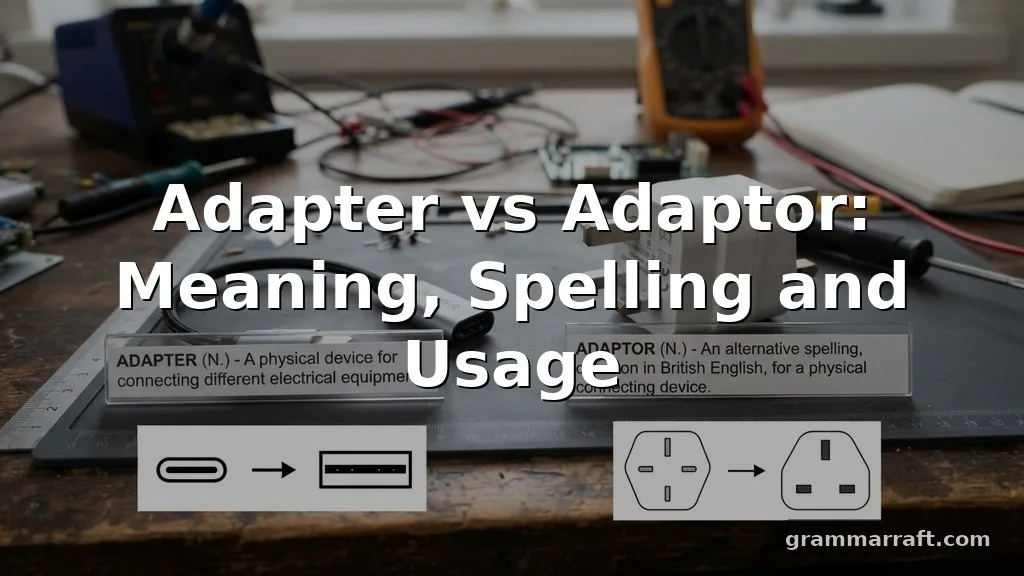
The difference in adapter vs adaptor is usually spelling, not function. Both words describe something that adapts, connects, or allows one system to work with another, although “adapter” is more common in many modern technical contexts.
You may see a laptop power adapter, a travel plug adaptor, or a connector adapter in product instructions. The preferred form can vary by country, industry, publisher, and even the age of the dictionary being consulted.
This article explains which spelling to choose, why both forms exist, how usage differs between American and British English, and why adapter should not be confused with adopter. It also covers chargers, voltage converters, plug adapters, and practical examples you can use in your own writing.
Adapter vs Adaptor: The Short Answer
Adapter and adaptor are both correct spellings. They generally mean the same thing: a person or device that modifies, connects, or enables one thing to work with another.
“Adapter” is usually the safer choice for general writing, especially in American English and in modern technology-related writing. “Adaptor” is also standard, particularly in British English and in some technical, mechanical, or product-specific contexts.
| Question | Best general answer |
|---|---|
| Are adapter and adaptor different words? | Usually no; they are spelling variants with the same core meaning. |
| Which spelling is more common? | Adapter is generally more common in current English. |
| Which form should American writers use? | Adapter is normally the natural choice. |
| Which form should British writers use? | Both occur, but adaptor is familiar in British technical and electrical usage. |
| Is a power adapter different from a power adaptor? | No. The spelling changes, not the basic function. |
The choice can still matter for consistency. If a manufacturer, employer, academic style guide, or technical standard uses “adaptor,” it makes sense to preserve that spelling rather than changing it throughout a document.
For a dictionary reference, the Merriam-Webster entry for adapter records the word’s meanings and related usage. Dictionaries may list one spelling as the main headword while identifying the other as a variant, but that does not automatically make the variant incorrect.
What Does Adapter Mean?
An adapter is something that makes two otherwise incompatible things work together. The word can refer to a physical device, a person who changes written material for another medium, or a component that alters a connection, format, or operating condition.
A common example is a power adapter. A laptop may receive power through an adapter that converts electricity from a wall outlet into the voltage and current required by the computer.
The word also appears in electronics. A USB adapter can allow a device with one connector type to communicate with another, while a network adapter enables a computer to connect to a wired or wireless network.
Physical and technical meanings
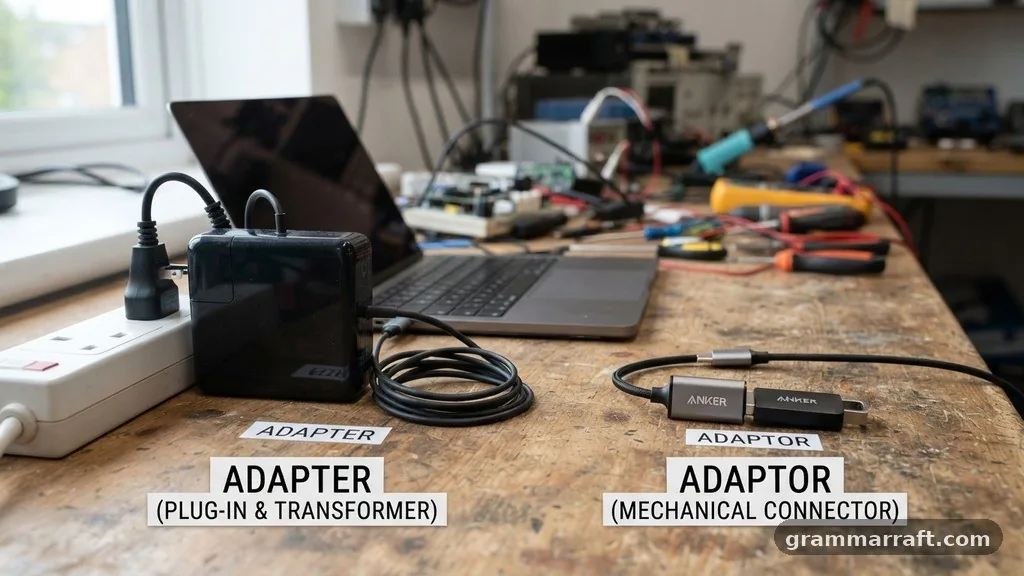
In hardware, an adapter often sits between two parts that do not directly match. A USB-C to HDMI adapter, for example, may allow a compatible computer to send video to an HDMI display, although the exact capabilities depend on the ports and electronics involved.
A mechanical adapter performs a similar job in a different setting. A camera lens adapter can let a photographer mount a lens with one fitting on a camera body with another, provided the adapter supports the relevant dimensions and functions.
The device does not always convert electrical power. Sometimes it only changes the shape, size, thread, connector, or interface so that two components can be joined.
People can be adapters, too
Adapter is not limited to equipment. A person who turns a novel into a screenplay may be called an adapter because they have adapted one work for a different medium.
See Also: People Do vs People Does: Which Is Correct?
That meaning is less likely to appear in everyday technology questions, but it explains why the word has a broader definition than “charger.” A power adapter is one kind of adapter, not the entire meaning of the word.
- A power adapter changes electrical power into a form a device can use.
- A connector adapter joins interfaces with different physical designs.
- A network adapter connects a device to a network.
- A lens adapter allows compatible camera components with different mounts to work together.
- An adapter in publishing or film changes a work for a new format.
This shared idea is the key to the word: an adapter helps one thing fit, connect, or function with another.
What Does Adaptor Mean?
Adaptor has the same basic meaning as adapter. It can describe an electrical device, a mechanical fitting, a connector, or a person who adapts material from one form to another.
You might see “plug adaptor” on British product packaging or in travel advice. In another document, the same item may be called a “plug adapter.” The object itself has not changed.
The spelling with “-or” follows a pattern found in some English words derived from verbs ending in “-ate.” English has never applied that pattern consistently, which is why both adapter and adaptor developed and remained in use.
Why the spelling varies
English spelling often preserves multiple forms when different regions, professions, or publishers adopt them. Adapter became especially prominent in American English and in newer technology vocabulary, while adaptor has remained well established in British English and certain specialist uses.
That does not create a reliable rule that every British writer must use adaptor or every American writer must use adapter. Real usage is more flexible than that.
Some companies choose “adaptor” in product names because it matches their catalog, industry tradition, or regional market. A writer describing that product should normally keep the official name intact.
Is adaptor more formal?
Not necessarily. Adaptor can look more technical or traditional to some readers, but the spelling itself does not make a sentence more formal.
“Connect the adaptor to the socket” and “Connect the adapter to the socket” are equally clear. The more important issues are whether the device is suitable, whether the connection is secure, and whether the electrical specifications match.
If you are choosing a spelling without a house style, use adapter for broad digital and international content. If you are writing for a publication or audience that consistently uses adaptor, follow that convention instead.
Adapter or Adaptor in American and British English
Regional preference is one of the main reasons people encounter both spellings. American English generally favors adapter, especially in product descriptions involving computers, chargers, audio equipment, and other consumer electronics.
British English uses both forms. Adaptor is common in phrases such as plug adaptor, travel adaptor, and mains adaptor, while adapter also appears in technical documentation, computing, and international product descriptions.
Other English-speaking regions may use either spelling depending on local publishing practice and the source of the product terminology. Canadian, Australian, and New Zealand usage can vary across industries and organizations.
| Context | Likely preferred form | Example |
|---|---|---|
| American consumer electronics | Adapter | laptop power adapter |
| British travel products | Adaptor is common | universal travel adaptor |
| Computing documentation | Adapter is common | wireless network adapter |
| Manufacturer’s product name | Use the company’s spelling | the listed product name |
| General-purpose writing | Adapter is a safe default | USB-C adapter |
Regional spelling is not a technical specification
A product labeled “adaptor” is not automatically different from one labeled “adapter.” The label may reflect the seller’s preferred spelling rather than a different circuit, connector, or performance standard.
For electrical equipment, focus on the specifications printed on the device or its documentation. Voltage, current, polarity, plug shape, and compatibility matter far more than the final letter of the noun.
Regional language still matters for search, editing, and customer communication. If a British audience searches for travel adaptor, using that wording in a relevant page can make the content feel more natural, while an American audience may expect travel adapter.
Power Adapter, Charger, and Voltage Converter
People often use adapter, charger, and voltage converter as if they were interchangeable. They overlap in some products, but they describe different functions and should not be treated as exact synonyms.
A power adapter supplies or changes electrical power for a device. A charger is designed to charge a battery, although a charger may contain an adapter or power supply as part of its design.
A voltage converter changes the voltage from one level to another. That is especially important during international travel, because a plug adapter may change the physical connection without changing the voltage.
Why a plug adapter may not be enough
A plug adapter allows a plug from one country to fit an outlet used in another country. It normally does not transform the electricity coming from that outlet.
Suppose a device is designed only for one voltage range and the destination uses a different standard. A plug adapter alone may leave the device exposed to unsuitable voltage, so the traveler may need a voltage converter or a device with a compatible input range.
Many modern laptop and phone power supplies accept a range of input voltages, but that should be confirmed on the label or manufacturer’s instructions. Never assume that a familiar connector guarantees electrical compatibility.
See Also: Do You vs Are You: Meaning, Grammar, and Usage?
- Plug adapter: changes the physical plug shape or connection.
- Power adapter: supplies or conditions power for a device.
- Charger: manages the process of charging a battery.
- Voltage converter: changes electrical voltage from one level to another.
- Transformer: uses electromagnetic induction to change alternating-current voltage in suitable equipment.
These terms can appear together in one product description, but they should not be assumed to describe the same internal function. If safety is involved, read the rating label rather than relying on the product’s marketing name.
Adapter vs Adaptor in Technology and Everyday Writing
Technology has helped make adapter the more visible spelling for many readers. Wireless adapter, Bluetooth adapter, USB adapter, graphics adapter, and power adapter are all familiar phrases in computing and electronics.
That pattern may be partly influenced by American software and hardware documentation, where adapter is widely used. It does not mean adaptor is wrong in a technical sentence.
In everyday writing, choose the term that best matches the audience and object. A travel company serving British customers may naturally write “international plug adaptor,” while an American electronics retailer may write “universal plug adapter.”
Consistency matters more than forced uniformity
Do not alternate randomly between adapter and adaptor in the same article. Readers may wonder whether the two spellings refer to different products, even though they usually do not.
Choose one form for ordinary references, then preserve a brand’s official spelling when you quote a product name. This approach keeps the copy readable without rewriting names that may be part of packaging, catalog data, or legal documentation.
Search behavior can also influence a web page. A page about a travel adaptor can mention the alternative spelling once in a natural explanation, allowing readers who search for travel adapter to find the same answer without making the text repetitive.
Examples in sentences
Here are practical examples showing how the word works in context:
- “The monitor requires a compatible power adapter.”
- “Pack a plug adaptor if your destination uses a different socket shape.”
- “The wireless network adapter stopped appearing in the computer settings.”
- “This lens adapter fits the older camera mount.”
- “The screen version was written by a different adapter.”
Each sentence uses the word for a connecting, modifying, or transforming role. The spelling can change according to house style, but the sentence meaning remains clear.
Adapter vs Adaptor vs Adopter
Adapter and adaptor are spelling variants. Adopter is a different word.
An adopter is a person or organization that accepts, chooses, or begins using something. For example, a company may be an early adopter of a new software system, while a family may adopt a child.
An adapter, by contrast, modifies or connects something so it can work in a new setting. Confusing the two can produce a sentence with a completely different meaning.
| Word | Meaning | Example |
|---|---|---|
| Adapter | A device or person that makes something fit another use | She bought a USB adapter. |
| Adaptor | An alternative spelling of adapter | The plug adaptor fits the outlet. |
| Adopter | A person or organization that accepts or starts using something | The company was an early adopter of the system. |
A simple memory aid
Think of an adapter as something that adapts. Think of an adopter as someone who adopts.
The words sound similar, especially in fast speech, but their endings point to different actions. A device adapter changes a connection; a technology adopter chooses to use a technology.
Proofreading software may not catch every confusion because all three words are valid dictionary entries. The surrounding meaning must guide the choice.
How to Choose the Right Spelling
For most general-purpose writing, adapter is the easiest default. It is widely recognized, common in American English, and strongly established in computing and consumer electronics.
Use adaptor if it matches your audience, publication style, product name, or established technical vocabulary. There is no need to “correct” a legitimate use simply because another spelling is more familiar to you.
A practical decision process
Start by identifying the audience. A US technology manual may naturally use adapter, while a UK travel website may prefer adaptor for a product category its readers already recognize.
Next, check the style guide or terminology list that governs the document. Corporate documentation, regulated industries, and product catalogs often require consistent naming across hundreds of pages.
Finally, check the manufacturer’s wording if you are describing a specific item. Product names can contain either spelling, and changing the name may make it harder for customers to match your description with the packaging or support documentation.
See Also: Could or Can: Meaning, Difference, and Correct Use?
- Use adapter as the broad default when no style preference exists.
- Use adaptor when it fits the regional or technical context.
- Keep one spelling consistent within the same piece of writing.
- Distinguish both forms from adopter.
- For electrical products, verify voltage and current separately from spelling.
There is rarely a need to use both forms repeatedly for SEO. A clear explanation of the variant is enough, after which the page should read naturally for human visitors.
FAQ: Common Questions About Adapter vs Adaptor
Is adapter or adaptor the correct spelling?
Both are correct spellings in standard English. Adapter is often the safer general choice, while adaptor is also established and may be preferred by a particular region, publisher, or technical industry.
Is it called a power adapter or a power adaptor?
Both phrases are acceptable and usually refer to the same kind of device. Power adapter is more common in much American technology writing, while power adaptor appears regularly in British and international product descriptions.
Is a plug adapter the same as a voltage converter?
No. A plug adapter changes the physical shape or connection of a plug, while a voltage converter changes electrical voltage. A traveler may need one or both, depending on the device and the electrical system at the destination.
What is the difference between adapter and adopter?
An adapter connects or modifies something so it can work in another context. An adopter is a person or organization that accepts, chooses, or begins using something, such as a new technology or process.
Should I use adapter or adaptor in a formal document?
Check the document’s style guide, audience, and product terminology first. If no preference exists, adapter is a clear and widely recognized default, but adaptor is not informal or incorrect.
Conclusion
Adapter vs adaptor is mainly a question of spelling preference rather than meaning. Both forms describe something that helps people, devices, or systems connect or work together, although adapter is generally the most versatile default and adaptor remains fully legitimate in many regional and technical contexts.
Choose one spelling, keep it consistent, and check the surrounding technical details separately. A plug adapter is not automatically a voltage converter, and neither spelling should be confused with adopter. Once that distinction is clear, you can write about an adapter or adaptor confidently and accurately.




2 Comments