Entwined vs Intertwined: Meaning, Difference and Usage
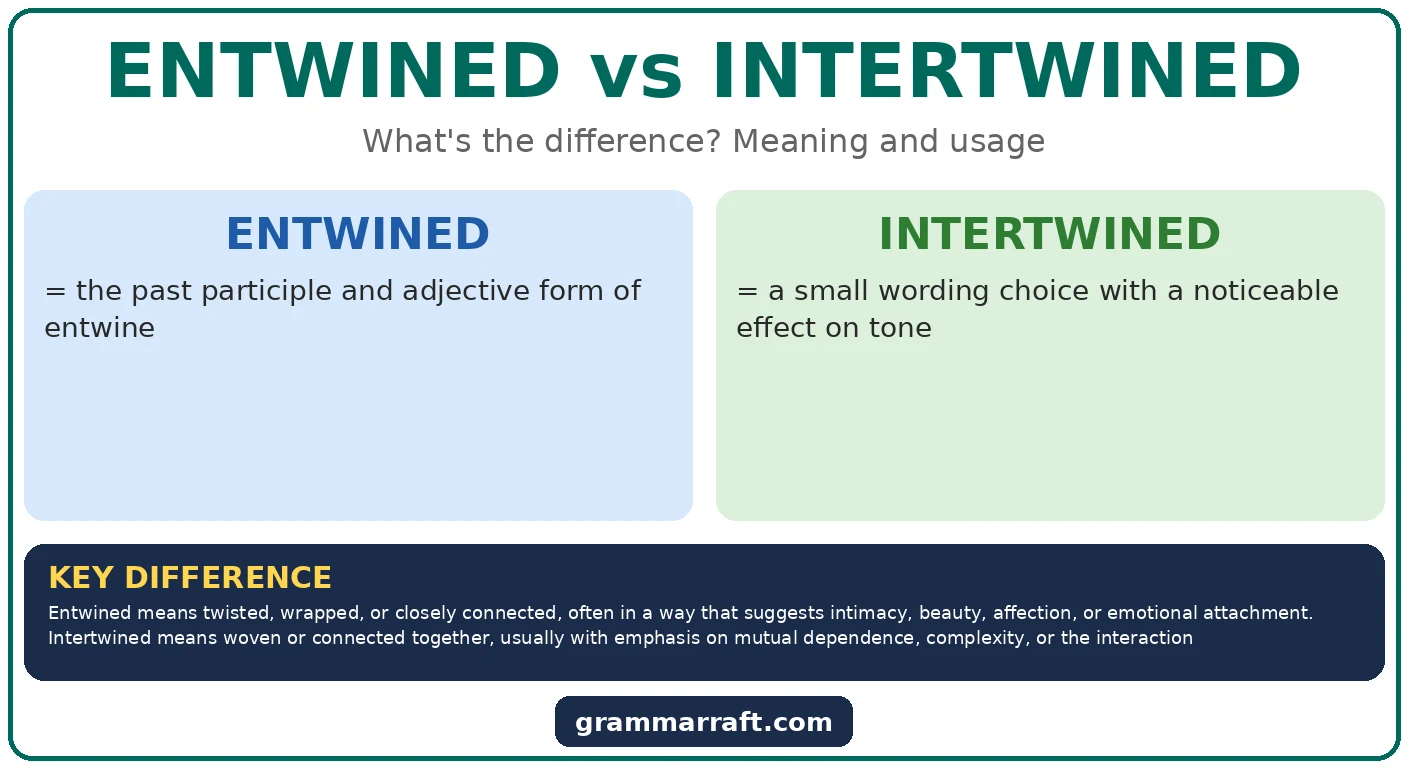
Entwined vs intertwined is a small wording choice with a noticeable effect on tone. Both words describe things joined, twisted, or closely connected, but they don’t always suggest the same kind of relationship.
The difference is mainly one of emphasis: entwined often creates a physical, emotional, or romantic image, while intertwined more strongly suggests several parts becoming connected with one another.
Once you understand that distinction, you’ll know which word fits a description of hands, vines, histories, cultures, or relationships. You’ll also see why the two words are often interchangeable, yet not always equally natural in a particular sentence.
Entwined vs Intertwined: The Short Answer
Entwined means twisted, wrapped, or closely connected, often in a way that suggests intimacy, beauty, affection, or emotional attachment. Intertwined means woven or connected together, usually with emphasis on mutual dependence, complexity, or the interaction of multiple parts.
For example, “Their fingers were entwined” sounds intimate and gentle. “Their economic systems were intertwined” sounds more analytical and stresses that each system affects the other.
| Word | Primary emphasis | Common tone | Natural examples |
|---|---|---|---|
| Entwined | Twisting, wrapping, or close attachment | Poetic, emotional, romantic, or visual | Entwined hands; entwined vines; entwined lives |
| Intertwined | Mutual connection among parts or systems | Neutral, analytical, social, or descriptive | Intertwined histories; intertwined economies; intertwined themes |
Neither word is automatically correct in every sentence. The best choice depends on whether you want readers to picture things physically wrapped together, or to understand that separate elements are connected in a more complicated way.
They are also both standard English words. If a sentence says that two lives are entwined or intertwined, the meaning will usually be clear either way, although the emotional color may change.
What Does Entwined Mean?
Entwined is the past participle and adjective form of entwine. To entwine something is to twist, wind, or wrap it around another thing, as two strands of thread, climbing plants, branches, or a person’s arms.
The word can describe a visible physical arrangement. “The ivy was entwined around the fence” tells us that the ivy had grown or curled around the structure, creating a clear image of one thing winding around another.
Entwined can also describe an emotional or figurative bond. Writers may say that two people’s lives became entwined, meaning their experiences became closely connected through love, family, friendship, work, or shared circumstances.
Physical uses of entwined
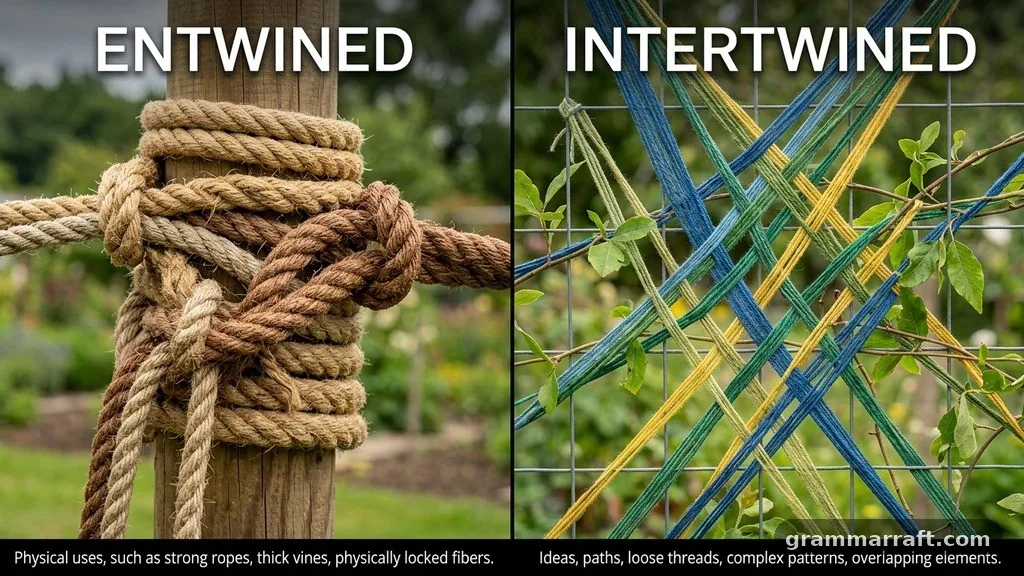
Physical examples of entwined tend to involve flexible or winding objects. Hair, roots, ribbons, vines, branches, cables, and fingers can all be described as entwined because they can wrap around, cross over, or curl together.
- Two children sat with their legs entwined beneath the table.
- Rose stems were entwined around the old iron gate.
- The dancer moved with a scarf entwined around her wrist.
- The cat slept with its tail entwined around its paws.
These examples share a visual quality. The reader can imagine a shape that has been twisted or wrapped, often in a relatively close and graceful arrangement.
Figurative and emotional uses
In figurative writing, entwined often suggests closeness rather than merely contact. “Their memories were entwined” implies that the memories overlap so closely that separating one person’s experience from the other’s may be difficult.
The word is especially common in romantic language. “Their hearts were entwined” does not describe literal anatomy; it presents love as a bond in which two emotional lives have become closely joined.
That use can sound lyrical or dramatic. In a formal academic paper, “entwined” may be less suitable than “interconnected” or “intertwined” unless the writer deliberately wants a metaphorical or literary tone.
What Does Intertwined Mean?
Intertwined is the past participle and adjective form of intertwine. It describes things woven, twisted, or connected together so that the individual parts interact or become difficult to separate.
The prefix inter- can help explain the word’s usual emphasis. It often points to a relationship between or among parts, suggesting reciprocal connection rather than one object simply wrapping around another.
“The two countries have intertwined histories” means their historical development has affected one another. The phrase doesn’t necessarily suggest affection, beauty, or physical twisting; it focuses on shared events and mutual influence.
Physical uses of intertwined
Intertwined can describe physical objects, particularly when several strands, wires, roots, or branches cross through one another. The image may be denser or more complex than the image created by entwined.
For instance, “intertwined wires” suggests multiple wires crossing or winding together. “Intertwined roots” may suggest an underground network in which the roots of different plants overlap and affect the available space.
It is not wrong to call these objects entwined. The choice of intertwined simply highlights the fact that the elements are woven together as a group or system.
Figurative and analytical uses
Intertwined is common in discussions of politics, economics, technology, history, culture, and social relationships. A writer might describe language and identity as intertwined, or say that public health and housing policy are intertwined issues.
In those contexts, the word signals complexity. It tells the reader that the topics are not merely related but influence one another in ways that make them hard to analyze in isolation.
That makes intertwined a comfortable choice in academic and professional writing. It remains vivid enough to create an image, but it usually sounds less romantic and less ornamental than entwined.
The Main Difference Between Entwined and Intertwined
The simplest difference is this: entwined emphasizes close wrapping or attachment, while intertwined emphasizes mutual connection among separate elements. That is a tendency, not an absolute grammatical rule.
Both words can describe bodies, objects, ideas, lives, and histories. Their dictionary meanings overlap because both come from verbs describing things that wind or twist together.
| Context | More natural choice | Why |
|---|---|---|
| Two lovers holding hands | Entwined | It conveys intimacy and a close physical image. |
| Two nations with shared historical events | Intertwined | It emphasizes mutual development and influence. |
| Vines around a tree | Either | Both words can describe plants winding together. |
| Several academic themes | Intertwined | It suits a complex relationship among ideas. |
| Two fictional characters’ lives | Either | Entwined is more lyrical; intertwined is more neutral. |
Consider the difference between “entwined destinies” and “intertwined destinies.” The first sounds more literary and possibly romantic or fateful, while the second sounds more concerned with the way the destinies affect one another.
There is no universal rule saying that one word must be used for people and the other for ideas. Meaning comes from the subject, the surrounding words, and the tone the writer wants to create.
Physical connection versus mutual connection
Entwined often gives the reader a picture of one thing winding around another. The relationship may be close, but the sentence does not always explain how much each part affects the other.
Intertwined more readily suggests a two-way or many-way relationship. If careers, families, or political events are intertwined, each may shape the others rather than simply sit beside them.
This distinction is useful, but it should not be treated as a rigid definition. Natural English allows overlap, and skilled writers sometimes choose a less expected word precisely because of its emotional or stylistic effect.
Entwined or Intertwined Hands?
For hands, entwined is usually the more natural choice when the image is affectionate or romantic. “They walked through the park with their fingers entwined” creates a familiar picture of two people holding hands with their fingers woven together.
Intertwined hands is also grammatically possible. It sounds slightly more descriptive and less intimate, as though the writer is concentrating on the physical arrangement rather than the relationship between the people.
Compare these sentences:
- Her fingers were entwined with his. This sounds tender, personal, and emotionally charged.
- The dancers’ hands became intertwined. This focuses on movement, pattern, and physical coordination.
- Their hands were intertwined as they exchanged vows. This is correct, but the context supplies the romantic tone.
The same principle applies to arms. “They sat with their arms entwined” often suggests affection or closeness, while “their arms were intertwined during the performance” may emphasize choreography or a complicated physical position.
“Entwined in love” and related expressions
“Entwined in love” means closely bound by romantic feeling. It is a poetic expression, not a technical phrase, so its effect depends on the surrounding style.
A romance novel may use “their souls were entwined in love” without sounding unusual. A business report would not normally use that expression because the emotional metaphor would conflict with the report’s practical tone.
Other natural expressions include “entwined lives,” “entwined hearts,” and “entwined fates.” These phrases suggest that two people’s futures or emotional experiences have become inseparable.
Intertwined can work in the same setting, but it creates a slightly different impression. “Their lives were intertwined by years of friendship” sounds less ornamental and more focused on the shared history that produced the connection.
Entwined and Intertwined in Literature and Modern Writing
Literary writers often choose entwined because it carries a strong visual and emotional image. A description of entwined branches can quietly suggest dependence, confinement, protection, or desire, depending on the scene around it.
The word can also make an abstract idea feel bodily and tangible. If a novelist says that grief is entwined with memory, the reader is encouraged to imagine the two experiences winding around one another rather than existing as separate feelings.
Intertwined is equally useful in literature, especially when a story has multiple characters, timelines, motives, or themes. A writer may describe several plotlines as intertwined when events that first appear separate gradually influence one another.
How tone changes the meaning
Tone is the attitude or feeling created by a writer’s word choices. Entwined often contributes a lyrical, intimate, sensual, or dramatic tone, although it can also describe ordinary physical objects.
Intertwined tends to be more restrained. It can still sound elegant, but it is widely used in essays, criticism, journalism, and academic writing because it describes complex relationships without necessarily making them sentimental.
Here is how the tone shifts:
- “The lovers’ fates were entwined” sounds romantic and almost mythic.
- “The characters’ fates were intertwined” sounds literary but more neutral.
- “The themes of memory and identity were intertwined” sounds analytical.
- “Memory was entwined with the character’s sense of home” sounds more poetic and personal.
Neither tone is automatically better. A novelist may want the emotional force of entwined, while a critic may prefer the precision and neutrality of intertwined.
Use in academic and professional writing
In academic writing, intertwined is often the safer choice for describing systems, causes, historical developments, or disciplines. It tells readers that the relationship is significant and reciprocal without making the prose sound overly decorative.
For example, “The development of printing and literacy was intertwined with changes in education” presents a historical relationship clearly. “The development of printing and literacy was entwined” is understandable, but it sounds more metaphorical and may feel less precise.
Professional writers should still choose based on context rather than banning entwined. A museum description, literary essay, or cultural feature may benefit from its visual force, especially when the subject involves art, ritual, memory, or identity.
For additional dictionary information, the entry for entwine and its related forms provides definitions, pronunciations, and usage details.
Common Mistakes to Avoid
The biggest mistake is assuming that the words are either completely identical or completely separate. They overlap substantially, but readers can still notice differences in tone and emphasis.
Mistake 1: Treating entwined as an error
Some writers believe that intertwined is the only correct form because it contains twined with the prefix inter-. That is incorrect. Entwined is a standard word with its own established meaning and long history of use.
Use it confidently when the sentence calls for the idea of wrapping, close attachment, or emotional intimacy. “Entwined roots” and “entwined lives” are not grammatical mistakes.
Mistake 2: Using intertwined for every relationship
Intertwined can describe many kinds of connection, but it may sound unnecessarily formal in a simple physical sentence. “The ribbons were intertwined” is fine, yet “the ribbons were entwined” may create a cleaner image of ribbons winding around each other.
Likewise, “their fingers were intertwined” is correct, but “their fingers were entwined” often sounds more natural if the scene is tender or romantic.
Mistake 3: Confusing the words with “entangled”
Entangled is related but not interchangeable in every context. It often suggests disorder, difficulty, obstruction, or an unwanted complication, as in “entangled wires” or “entangled in a legal dispute.”
Entwined and intertwined can be positive, neutral, or negative depending on context. Entangled more strongly hints that something is caught, messy, or hard to escape.
Mistake 4: Ignoring the sentence’s tone
A technically correct synonym can still be a poor stylistic choice. If a formal report says that two agencies are “romantically entwined,” the word choice may distract readers, even if the sentence is grammatically sound.
Before choosing, ask what the sentence should suggest: physical wrapping, affection, mutual influence, complexity, beauty, conflict, or dependence. The answer usually points toward the most suitable word.
How to Choose the Right Word
Start by identifying what is actually connected. Are you describing hands, branches, wires, memories, economies, plotlines, or personal histories? The subject gives you the first clue, but the intended tone supplies the final decision.
Next, decide whether the relationship is mainly visual or conceptual. If you want readers to picture one thing curling around another, entwined may be the stronger choice. If you want to explain how separate parts influence one another, intertwined may be clearer.
Read the entire sentence aloud. This simple test catches awkward choices because the two words have different rhythms and emotional weight, even when their dictionary meanings overlap.
| If you mean… | Try… | Example |
|---|---|---|
| Wrapped closely around something | Entwined | The creeper was entwined around the post. |
| Several parts affecting one another | Intertwined | Language and culture are intertwined. |
| A romantic or intimate bond | Entwined | Their lives became entwined. |
| A complex historical relationship | Intertwined | The region’s histories are intertwined. |
| A poetic description where either works | Choose by tone | Their stories were entwined or intertwined. |
A practical editing checklist
- Check whether the word describes a physical arrangement or an abstract relationship.
- Choose entwined for a more intimate, visual, or poetic effect.
- Choose intertwined for mutual influence, complexity, or a neutral analytical tone.
- Replace both words with “connected” if the image is unnecessary and plain clarity matters most.
- Use “entangled” only when you want to suggest complication, disorder, or difficulty.
Sometimes the best revision is not choosing between the two words. If the sentence is intended for a technical audience, “closely connected,” “interdependent,” or “mutually influential” may communicate the idea more directly.
On the other hand, replacing every vivid word with a plain synonym can weaken creative writing. The goal is not to eliminate imagery but to make sure the imagery serves the sentence’s purpose.
Examples of Entwined vs Intertwined in Sentences
Examples make the distinction easier to feel because they show how context controls interpretation. The following pairs are not about right versus wrong; they demonstrate how a small word change can adjust the reader’s impression.
People and relationships
“Their lives became entwined after the accident” suggests an intimate or fateful bond formed through shared experience. “Their lives became intertwined through years of cooperation” places more emphasis on the ongoing interaction between them.
“The couple slept with their legs entwined” creates a physical and affectionate image. “The athletes’ legs became intertwined during the contest” sounds more functional and may suggest complicated movement rather than romance.
Nature and objects
“The vines were entwined around the balcony” presents the vines as curling around a structure. “The vines were intertwined beneath the canopy” suggests a network of vines crossing and weaving together.
“The threads were entwined into a decorative cord” highlights the act of winding them into a unified form. “The threads were intertwined throughout the fabric” emphasizes how the strands are distributed across the material.
Ideas and institutions
“The poet’s identity was entwined with the landscape” sounds personal and expressive. “The poet’s identity and the region’s politics were intertwined” sounds more analytical and indicates mutual influence.
“Technology and education are intertwined” is a natural general statement. “Technology and education are entwined” is possible, but it gives the sentence a more literary or metaphorical quality.
For a quick test, substitute “woven together” in your sentence. If the image feels concrete and intimate, entwined may fit. If “connected in a complex, mutual way” is closer to your intended meaning, intertwined is probably the better choice.
Frequently Asked Questions
Is it entwined or intertwined?
Both are correct words. Use entwined when you want to emphasize wrapping, closeness, or a poetic or emotional bond; use intertwined when you want to emphasize mutual connection, complexity, or interaction among parts.
Are entwined and intertwined synonyms?
They are near-synonyms, not perfect substitutes in every situation. Both can mean joined or twisted together, but entwined often sounds more intimate or visual, while intertwined often sounds more neutral and analytical.
What does “entwined in love” mean?
It means that two people are closely bound by romantic affection. The expression is figurative and poetic, suggesting that their emotional lives, feelings, or futures have become deeply connected.
What does intertwined mean in simple words?
Intertwined means connected or mixed together so closely that the parts affect one another or are difficult to separate. Histories, ideas, families, economies, and physical strands can all be intertwined.
Is “intertwined hands” grammatically correct?
Yes. “Intertwined hands” is grammatically correct and describes hands or fingers woven together. If the scene is affectionate, “entwined hands” may sound warmer, while “intertwined hands” can sound more neutral or physically descriptive.
Conclusion
Entwined vs intertwined is mainly a question of emphasis and tone, not a battle between a correct word and an incorrect one. Entwined tends to suggest wrapping, intimacy, and poetic closeness, while intertwined more often describes mutual influence, complexity, and connection among several parts.
When you edit, picture the relationship first, then listen to the sentence. Choose the word that matches both the meaning and the mood, and use a plainer alternative such as “connected” if imagery would only distract. With that test in mind, you’ll rarely hesitate over entwined vs intertwined again.
Related Articles
- Pail vs Pale: Understanding the Difference Between Two Confusing English Words
- Extol vs Extoll: Understanding the Difference and Correct Spelling
- Most Important vs Most Importantly: Master This Common Grammar Difference
Explore more helpful guides on GrammarRaft.