GTG Meaning in Text: Definition, Uses & Examples
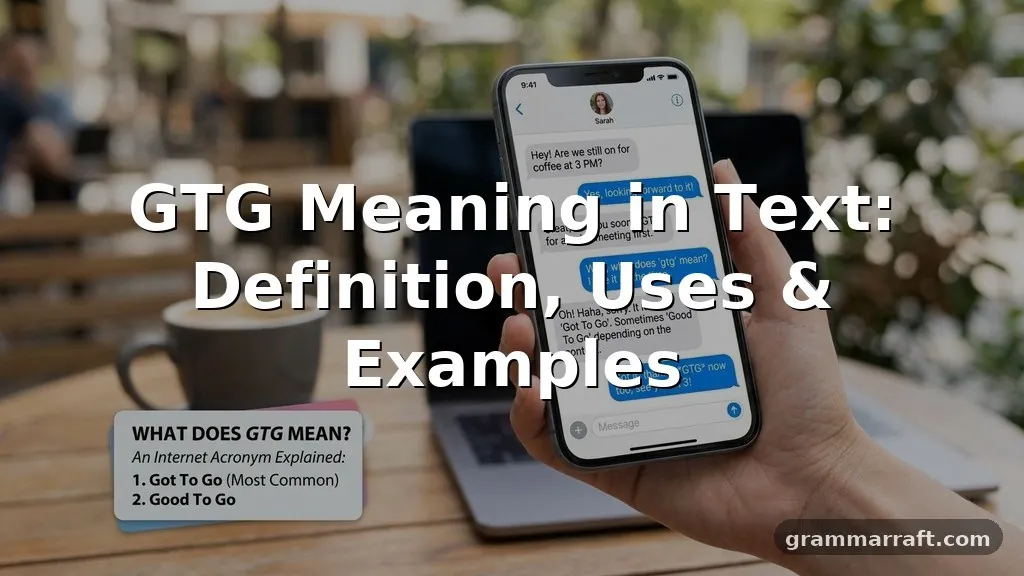
The gtg meaning in text is usually “got to go”, a quick way to tell someone that you need to leave a conversation, game, or activity. In some messages, GTG can also mean “good to go,” so the surrounding words matter.
This small acronym appears in texting, group chats, social media, online games, and casual email. The difference between “I’m gtg” and “Are we gtg?” is important: the first normally signals departure, while the second asks whether something is ready. You’ll find both meanings explained here, along with examples, tone advice, and answers to common questions about GTG.
What Does GTG Mean in Text?
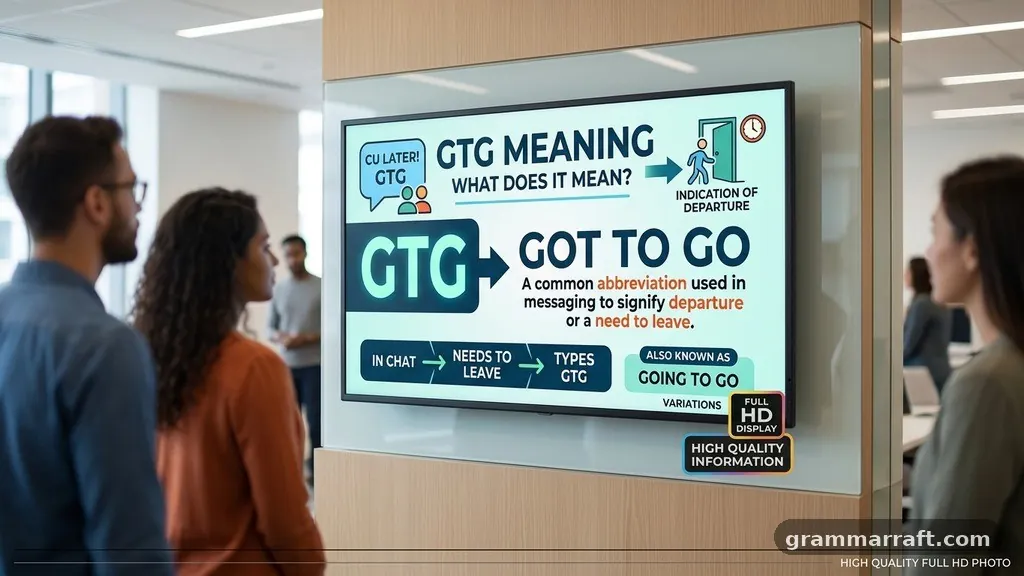
In most informal texting, GTG means “got to go.” Someone uses it to say they’re leaving or need to end the conversation. It is similar to “I have to go,” “I need to leave,” or “I’ve got to run,” but the acronym is faster to type.
For example, “GTG, my bus is here” clearly means the sender must leave. Likewise, “Sorry, gtg—talk later” closes a chat without suggesting anger or dislike.
GTG can also mean “good to go.” In that use, it describes a person, plan, task, or device that is ready. “Are you GTG?” means “Are you ready?” while “The presentation is GTG” means the presentation is ready for use.
| GTG meaning | Typical purpose | Example |
|---|---|---|
| Got to go | Ending a conversation or leaving | “GTG, dinner’s ready.” |
| Good to go | Confirming readiness | “The file is GTG.” |
| Gotta go | Casual variation of “got to go” | “GTG now—call you later.” |
The spelling is usually uppercase as GTG, but lowercase “gtg” is equally common in casual messaging. Capitalization rarely changes the meaning.
GTG as “Got to Go”
“Got to go” is the most common definition GTG has in a personal text. It tells the other person that the sender is ending the exchange, often because of a practical interruption such as work, school, dinner, a phone call, or travel.
The phrase is brief by design. Texting users often omit extra explanation because both people understand that a short message may be sent while someone is busy. “GTG” can therefore be a complete message, although adding a reason or goodbye usually sounds warmer.
- “GTG, my ride is here.” The sender needs to leave immediately.
- “I’m gtg to class.” The sender is heading to class.
- “GTG for now, talk tonight.” The sender is leaving but expects to continue later.
- “Sorry, gtg!” The sender is ending the chat politely and quickly.
- “GTG, battery’s at 1%.” The sender may lose access to the conversation.
In this sense, GTG is not usually a secret signal or a coded insult. It normally means exactly what it says: the person has to go. The tone depends on the rest of the message, punctuation, and the relationship between the people chatting.
“GTG, love you” feels affectionate, while “gtg” sent after an argument may feel abrupt. Still, the acronym itself does not prove that someone is annoyed, bored, or trying to avoid you.
GTG as “Good to Go”
The second major meaning is “good to go,” an expression that means ready, approved, or prepared. This version often appears in questions about plans, work, travel, equipment, and online activities.
Consider the difference between “I’m GTG” and “Are we GTG?” The first can mean “I have to go,” especially in a personal chat. The second usually means “Are we ready to start?” Context resolves the ambiguity.
Examples include:
- “Are we GTG for the meeting?” — Are we ready for the meeting?
- “The update is GTG.” — The update has been checked and is ready.
- “I’m GTG whenever you are.” — I’m ready to begin when you are.
- “Everything’s GTG for the trip.” — The arrangements are ready.
- “Your account should be GTG now.” — The account should be working or approved.
This use is common in workplace chats and gaming messages, although it remains informal. A project manager might write “Are we GTG?” in a team chat, but a formal report would normally say “Are we ready to proceed?” instead.
“Good to go” can also describe approval rather than physical readiness. If someone says a document is GTG, they may mean it has been reviewed and needs no more changes. That interpretation is especially likely when the conversation involves files, schedules, designs, or launch plans.
How Context Changes the Meaning
GTG is a context-dependent acronym. The words around it, the position of the message, and the activity being discussed all help identify the intended meaning.
A message at the end of a long personal conversation is likely to mean “got to go.” For example, “It was nice talking, GTG” has a clear farewell function. A message before an event or task is more likely to mean “good to go,” as in “GTG for 8 p.m.?”
| Message | Most likely meaning | Why |
|---|---|---|
| “GTG, my mom is calling.” | Got to go | The sender is ending the chat. |
| “Are you GTG for the match?” | Good to go | The question asks whether someone is ready. |
| “The laptop is GTG.” | Good to go | An object is being described as ready. |
| “GTG, see you tomorrow.” | Got to go | The closing phrase signals departure. |
| “We’re GTG after the final check.” | Good to go | The group will be ready after a task is completed. |
If you’re unsure, ask a short follow-up such as “Do you mean you have to go, or that you’re ready?” That may sound slightly formal, but it prevents confusion in an important conversation.
Punctuation can provide a clue, too. “GTG!” often marks a quick departure, while “Are we GTG?” clearly asks about readiness. These are clues, not strict rules; people use texting shorthand inconsistently.
GTG in Texting and Social Media
GTG belongs to the broad group of internet slang and texting abbreviations that developed because short messages were quick to type and easy to recognize. It sits alongside terms such as BRB, LOL, TTYL, IDK, and ASAP, though each abbreviation serves a different purpose.
“BRB” means “be right back,” while GTG normally means the person is leaving. “TTYL” means “talk to you later,” and it may accompany GTG: “GTG, TTYL.” That combination tells the recipient both that the current exchange is ending and that another conversation may happen later.
Common pairings include:
- GTG, TTYL — I have to go; we’ll talk later.
- GTG, BRB — potentially contradictory, unless the sender means they are leaving briefly and will return.
- GTG soon — the sender will need to leave shortly.
- Almost GTG — the person or plan is nearly ready.
- We’re GTG — the group or plan is ready to proceed.
Different age groups may interpret the abbreviation differently. Some users learned GTG through instant messaging, while younger users may encounter it in group chats, games, or social platforms. The expression remains understandable, but not everyone uses it with the same frequency.
For a broader reference on how abbreviations and informal language are recorded, the Merriam-Webster dictionary provides useful background on English words and usage. A dictionary entry can clarify a term, but the immediate conversation still supplies the final meaning.
GTG in Gaming, Roblox, and Group Chats
Online gaming gives GTG both meanings a clear role. A player might write “GTG, dinner” to leave a match or say “Everyone GTG?” to check whether the team is ready to queue.
In a game lobby, “gtg?” may mean “Are we good to go?” In a direct message during a game, “gtg” more often means “I have to go.” The presence of a question mark and the location of the message usually make the distinction easy.
Examples from gaming include:
- “GTG after this round.” The player will leave when the current round ends.
- “Are we GTG for the raid?” The team is being asked whether it is ready.
- “My internet’s bad, GTG.” The player is leaving because the connection is a problem.
- “All players GTG?” The leader is checking readiness.
- “GTG in five.” The player expects to be ready or available in five minutes, depending on context.
Roblox users and players of other online games may also use GTG alongside platform-specific slang. The acronym itself does not have a special Roblox-only definition. If someone claims “GTG” has a unique meaning in a particular game, check the surrounding exchange rather than assuming a hidden rule.
Group chats create another issue: one person’s GTG may not end the entire discussion. A member can leave the conversation while everyone else continues talking. If the message says “We’re GTG,” however, the plural pronoun suggests that the group is ready, not that one person is departing.
Is GTG Formal or Informal?
GTG is generally informal language. It works well in texting, casual direct messages, gaming chats, and relaxed conversations with coworkers who already use abbreviations. It is less suitable for formal letters, academic writing, official notices, or messages to someone who may not recognize texting slang.
In a workplace chat, “GTG, I’ll send the notes later” may be perfectly understandable. In a client email, “I have to leave now, but I’ll send the notes later” is clearer and more professional.
| Situation | GTG suitable? | Clearer alternative |
|---|---|---|
| Texting a close friend | Yes | “GTG, talk soon.” |
| Gaming with friends | Yes | “GTG after this match.” |
| Formal client email | Usually no | “I need to leave, but I’ll follow up later.” |
| School assignment | No | Use “got to go” or a complete sentence if relevant. |
| Internal team chat | Depends on the team | “We’re ready to proceed.” |
Professional tone depends on more than vocabulary. A short “GTG” can sound dismissive if a customer is waiting for help, even if the sender means no offense. In a formal setting, a complete sentence makes the message more precise and avoids asking the reader to decode slang.
If you use GTG with someone unfamiliar with texting abbreviations, write the full phrase first. After that, you can use the acronym if the conversation becomes more casual.
What GTG Can Mean in Different Contexts
Searches for GTG meaning in medical settings, workplace systems, or technical documents can produce different results because acronyms are not exclusive to texting. A three-letter abbreviation may represent a field-specific term that has nothing to do with “got to go” or “good to go.”
In medical, scientific, or administrative writing, the surrounding subject is essential. A patient record, laboratory document, or organization may define GTG according to its own terminology. Do not assume a casual texting meaning when the acronym appears in a professional record.
The same caution applies to “GTG” in business, transportation, education, and technology. An acronym may be a product name, department label, internal code, or technical abbreviation. Reliable interpretation requires the sentence, the document type, and sometimes the organization’s own glossary.
For everyday messages, these clues are helpful:
- If GTG appears beside a goodbye, it probably means got to go.
- If it follows “Are you” or “Are we,” it probably means good to go.
- If it describes a file, plan, device, or task, it probably means ready.
- If it appears in a specialized document, check the field-specific definition.
- If the message is ambiguous, ask rather than assigning emotional meaning to it.
That final point matters because readers sometimes search for what GTG means “from a guy” or “from a girl.” The acronym does not have a gender-specific definition. A person’s wording, timing, and relationship with you may affect tone, but GTG itself means the same thing regardless of who sends it.
How to Reply to “GTG”
The best reply depends on whether the sender is leaving or confirming readiness. If “GTG” means “got to go,” a brief farewell is enough: “No worries, talk later,” “Okay, see you soon,” or “Have a good night.” You don’t need to demand a detailed explanation.
If the message means “good to go,” respond to the plan or question directly. “Yes, I’m ready,” “Almost—give me five minutes,” or “The file is ready” removes uncertainty.
- When GTG means leaving: “Okay, talk later!”
- When readiness is unclear: “Do you mean you have to go or that you’re ready?”
- When someone asks “Are you GTG?”: “Yes, I’m ready.”
- When you aren’t ready: “Not yet—I need another ten minutes.”
- When ending your own chat: “GTG, but I’ll reply tomorrow.”
Adding a little context makes your own messages easier to understand. “GTG, my train is here” cannot reasonably be read as “good to go,” while “We’re GTG for the 7 p.m. start” clearly refers to readiness.
In sensitive conversations, avoid using only “gtg” if the other person may interpret it as rejection. “I need to go, but I’m not upset—we can finish this later” communicates both the practical reason and the emotional context.
FAQ About GTG Meaning in Text
What does GTG stand for in texting?
GTG most commonly stands for “got to go.” It tells someone that the sender needs to leave or end the conversation. Depending on context, it can also stand for “good to go,” meaning ready or approved.
What does GTG mean from a girl or a guy?
It has the same basic meaning regardless of who sends it. “GTG” from a girl or a guy usually means “got to go,” unless the surrounding conversation is about being prepared, in which case it may mean “good to go.”
What does GTG mean in gaming or Roblox?
In gaming, GTG can mean that a player has to leave, such as “GTG after this round.” It can also mean “good to go” when players are checking whether a team or lobby is ready to begin.
Is GTG rude in a text?
Not by itself. GTG is a normal informal abbreviation, but sending only “gtg” during an important conversation can feel abrupt. Adding “sorry,” a reason, or “talk later” usually makes the message friendlier.
Does GTG mean “good to go” or “got to go”?
It can mean either phrase. “GTG, my ride is here” means “got to go,” while “Are we GTG?” usually means “are we good to go?” The sentence and conversation provide the answer.
Conclusion
The gtg meaning in text is usually “got to go,” especially when it appears with a goodbye or a reason for leaving. In planning, gaming, and work chats, GTG can instead mean “good to go,” or ready to begin. Context, punctuation, and the words around the acronym make the distinction clear.
Use GTG freely in casual conversations, but choose a complete phrase in formal writing or sensitive discussions. If a message seems ambiguous, ask a quick question rather than guessing at the sender’s tone. That simple habit keeps short texting slang from creating a much bigger misunderstanding.