Situation vs Circumstance: Meaning, Examples and Usage
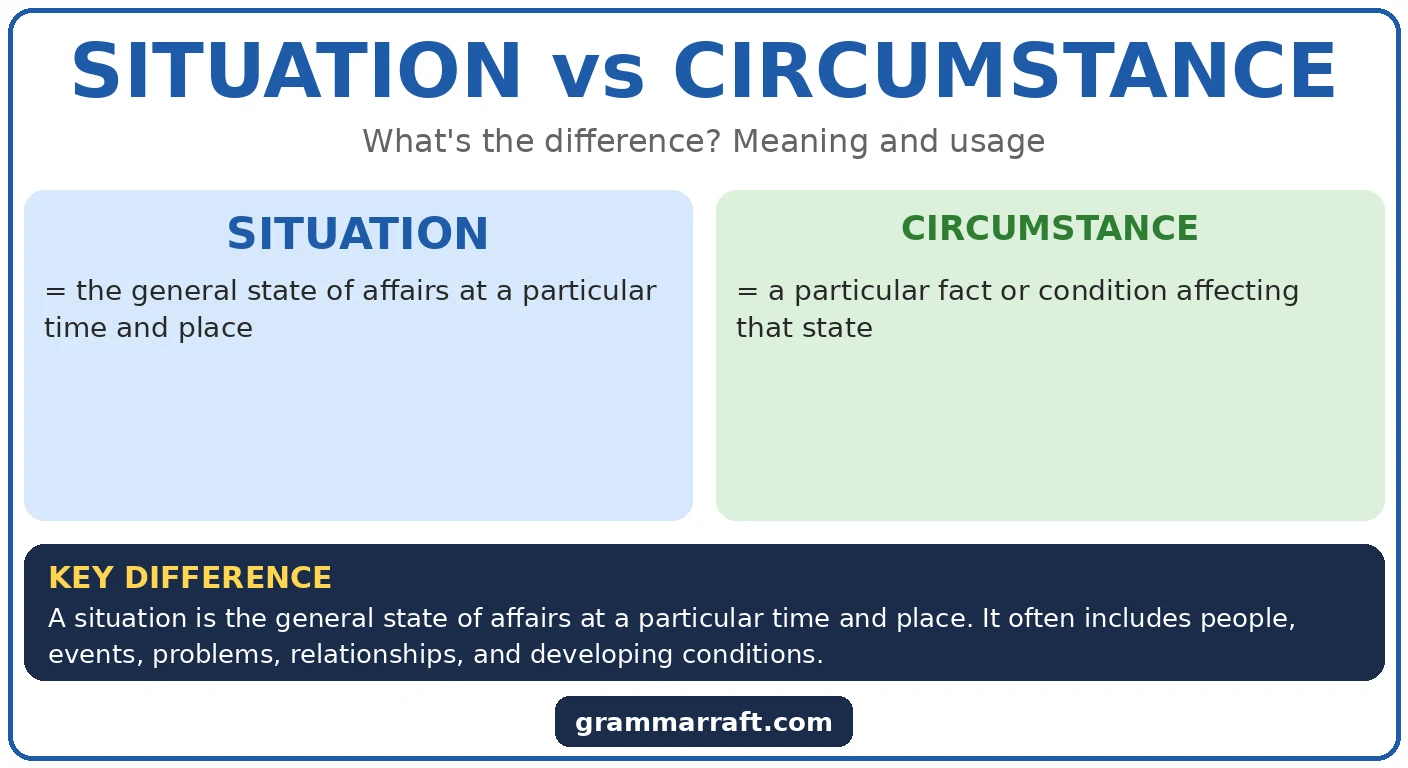
The difference between situation and circumstance is small but useful: a situation usually describes the overall state of affairs, while a circumstance is a particular fact or condition affecting that state. The words sound similar because they often appear in the same sentence, yet they point to different parts of the picture.
That distinction matters in ordinary conversation, school writing, professional communication, and legal language. Saying that someone is “in a difficult situation” gives a broad description; mentioning “the circumstances surrounding the decision” directs attention to the specific facts that shaped it.
This article explains the definitions, overlaps, grammar, and practical uses of both words. You’ll see side-by-side examples, comparisons with condition and event, and a simple method for choosing the more precise term.
The Short Answer: Situation vs Circumstance
A situation is the general state of affairs at a particular time and place. It often includes people, events, problems, relationships, and developing conditions. For example, “The company is in a difficult financial situation” describes the company’s broad position.
A circumstance is a fact, condition, or surrounding detail that helps explain a situation. In “The company delayed the launch because of unexpected circumstances,” the word points to particular factors that influenced the decision, even though those factors may not be named.
| Word | Main focus | Typical question answered | Example |
|---|---|---|---|
| Situation | The overall state of affairs | What is happening? | “We need to improve the current situation.” |
| Circumstance | A surrounding fact or influencing condition | What factors affect it? | “Under the circumstances, she made a sensible choice.” |
| Condition | A state, requirement, or standard | What state or requirement applies? | “The offer is subject to certain conditions.” |
| Event | Something that happens | What occurred? | “The event changed their plans.” |
The distinction is not absolute. Native speakers sometimes use the words almost interchangeably, especially in casual speech. Still, choosing the right term can make writing more exact: use situation for the whole picture and circumstance for a relevant surrounding fact.
What Does “Situation” Mean?
The noun situation refers to the position or state of affairs in which someone or something exists at a particular moment. It can describe a personal problem, a workplace development, a political condition, or an ordinary arrangement of people and things.
For example, “Maya is in a difficult situation” tells us that Maya faces a challenging set of facts. It does not identify the exact cause, and it does not necessarily explain how the problem began. The sentence gives the broad frame.
A situation can be temporary or long-lasting. A traffic jam is a short-term situation, while a country’s economic situation may develop over months or years. The word can also be neutral: “The situation at school is calm” simply describes what is happening without judging it.
Common uses of situation

- Personal circumstances viewed as a whole: “He is trying to improve his financial situation.”
- A problem requiring action: “The manager stepped in to resolve the situation.”
- A social or professional setting: “She handled the interview situation well.”
- A developing state of affairs: “The situation changed after the announcement.”
- A physical position or location: “The house has a beautiful situation overlooking the valley.”
The last use is less common in everyday modern English, but it appears in formal or literary writing. Most speakers use situation to mean a set of current facts, events, and relationships rather than a simple location.
Situation often pairs with words such as current, present, difficult, serious, complex, and unusual. These combinations show that the word is flexible: it can describe an emergency, a routine arrangement, or an unresolved question.
What Does “Circumstance” Mean?
A circumstance is a fact or condition that surrounds an event, decision, person, or action. It usually matters because it helps explain why something happened or why a person behaved in a certain way.
Consider the sentence, “The judge considered the circumstances before imposing a sentence.” Here, circumstances means the relevant details of the case. The word may include the person’s actions, the surrounding events, the effect on others, and any facts that make the case unusual.
Circumstance is often used in the plural, circumstances. The plural form is natural when several facts work together: “Under the circumstances, leaving early was sensible.” This means that the surrounding facts made leaving early a reasonable response.
Common uses of circumstance
The word frequently appears in phrases that connect facts with decisions or outcomes. “Due to circumstances beyond our control” indicates that external factors prevented an intended action. “Under no circumstances” creates a strong prohibition, as in “Under no circumstances should the equipment be left unattended.”
Another common expression is “in the circumstances,” especially in British English. “In the circumstances, the committee postponed the vote” means that the known facts made postponement understandable or appropriate. American English often uses “under the circumstances” for the same idea.
Circumstance can also refer to a person’s social or financial position. A statement such as “They live in modest circumstances” describes their material situation. In that use, the word is broader than one isolated fact and refers to the conditions surrounding someone’s life.
For a formal dictionary reference, the Cambridge Dictionary entry for circumstance provides pronunciation, definitions, and example sentences. Dictionary entries are especially useful when a word has several related senses.
How Situation and Circumstance Overlap
Both words describe reality as people experience it rather than a single object. Neither one must refer to a physical thing, and both can involve people, places, time, events, and decisions.
That overlap explains why “a difficult situation” and “difficult circumstances” can sometimes communicate nearly the same idea. If someone has lost a job and is struggling to pay rent, you might say that person is in a difficult situation or facing difficult circumstances.
The emphasis changes slightly. “Situation” presents the person’s overall problem, while “circumstances” highlights the facts surrounding it, such as job loss, debt, illness, or family responsibilities.
| Sentence | What the wording emphasizes |
|---|---|
| “The family is in a difficult situation.” | The family’s overall condition or problem |
| “The family is living under difficult circumstances.” | The external conditions affecting the family |
| “The circumstances led to a change in plans.” | The facts that produced the change |
| “The situation led to a change in plans.” | The broader state of affairs that produced the change |
In some sentences, either word works without creating a serious error. The choice depends on what you want the listener to notice. If you are describing the complete problem, situation is usually the clearer option; if you are explaining causes or surrounding facts, circumstance is often stronger.
Situation vs Circumstance in Sentences
Examples make the distinction easier to feel. Compare “The team is in a difficult situation” with “The team faced difficult circumstances.” The first sentence focuses on the team’s current position; the second suggests that external facts made success more difficult.
Personal life
“I need to explain my situation before you make a decision” introduces a broad personal account. The speaker may discuss money, health, family, or work because all of those details form the complete situation.
“I missed the appointment because of unusual circumstances” focuses on the reason for one action. The circumstances might include a sudden illness, a transport failure, or an emergency. The sentence does not require the speaker to describe every part of life.
Work and school
“The school is reviewing the situation” suggests an ongoing issue involving students, staff, or policy. The review may include what happened, who was involved, and what action should follow.
“The school took the student’s circumstances into account” means that decision-makers considered particular facts about the student. Those facts might affect how a rule is applied, but the sentence keeps attention on the surrounding details.
Public events
“The political situation changed after the election” describes a broad development involving institutions, groups, and public decisions. It may include several events rather than one isolated occurrence.
“The circumstances surrounding the resignation remain unclear” focuses on the facts connected with one event. The sentence suggests that people know the resignation happened but do not fully understand what led to it.
Natural collocations
Collocations are words that commonly appear together. Learning them helps writers use situation and circumstance naturally rather than relying only on a dictionary definition.
- Situation: current situation, difficult situation, serious situation, political situation, financial situation, situation changed.
- Circumstance: under the circumstances, due to circumstances, surrounding circumstances, exceptional circumstances, circumstances beyond our control.
“Difficult situation” sounds more natural than “difficult circumstance” when referring to a complete problem. “Exceptional circumstances” sounds more natural than “exceptional situation” when explaining why an ordinary rule should not apply.
Situation vs Circumstance vs Condition
Readers often compare circumstance with condition because the words can both describe factors affecting an outcome. Their meanings overlap, but condition commonly refers to a state, requirement, or standard, while circumstance usually refers to a surrounding fact.
“The patient’s condition improved” describes the patient’s state of health. “The patient’s circumstances made regular treatment difficult” describes external facts, such as transport, work hours, or family responsibilities.
Condition also has a strong contractual meaning. “You may return the item under the following conditions” introduces requirements that must be met. Circumstance would not normally be used there unless the sentence referred to unexpected facts affecting the return.
| Term | Core meaning | Example |
|---|---|---|
| Situation | The complete state of affairs | “The situation is becoming more complicated.” |
| Circumstance | A surrounding fact or influence | “The circumstances explain her decision.” |
| Condition | A state, requirement, or quality | “The machine is in good condition.” |
| Event | An occurrence or happening | “The event attracted public attention.” |
There is one important complication: condition can also mean a wider social or economic state, as in “working conditions” or “economic conditions.” In those expressions, condition may resemble situation, but the focus remains on the state or environment rather than the whole unfolding story.
A practical test helps. Ask whether you are naming the overall problem, a surrounding fact, a state, or something that happened. The answers usually point to situation, circumstance, condition, or event respectively.
Why the Difference Matters in Formal and Legal Writing
See Also: Northeast vs North East: Meaning, Spelling and Usage
Precision matters more in formal writing because readers may rely on the wording to understand responsibility, cause, or justification. A report might describe “the situation at the facility” before listing the circumstances that produced it.
Legal writing uses circumstance frequently because legal decisions often depend on specific facts. Phrases such as “the circumstances of the case,” “aggravating circumstances,” and “mitigating circumstances” direct attention to details that can affect interpretation or outcome.
For example, an aggravating circumstance is a fact that may make an offense more serious, while a mitigating circumstance is a fact that may support a less severe response. The exact legal effect depends on the jurisdiction and the relevant law, so ordinary dictionary meaning should not be treated as legal advice.
Situation still has an important role in professional writing. A policy report might say, “The current situation requires immediate review,” because it is describing the overall state of affairs. A later section could identify the circumstances that caused the problem.
Choosing neutral wording
Situation is often the safer neutral word when the writer does not yet know which facts matter most. “The situation is being investigated” avoids claiming that a particular person, action, or condition caused the issue.
Circumstance can sound more analytical because it invites questions about context and causation. “The circumstances of the decision should be examined” suggests that the decision cannot be understood by looking only at the final action.
Writers should avoid using circumstance to make a sentence sound formal if situation is clearer. Formality does not automatically create precision. The best word is the one that accurately identifies the part of reality being discussed.
Situation vs Circumstance in Psychology and Everyday Thinking
In psychology and ordinary reasoning, the distinction can help separate a person’s behavior from the context around it. A situation describes the setting or immediate state of affairs, while circumstances include the particular pressures and facts that shape a response.
Imagine a worker who leaves a meeting abruptly. The situation might be a tense disagreement in front of colleagues. The circumstances could include a sick child at home, a missed phone call, or a prior conflict that made the discussion especially stressful.
This distinction encourages fairer interpretation. Judging only the visible situation may lead someone to call the behavior rude or irrational. Considering the circumstances does not excuse every action, but it can produce a fuller and more accurate account of what happened.
The same principle applies to success. A student’s situation might be described as “performing well at school,” while the circumstances include access to quiet study space, reliable technology, supportive adults, health, and available time. Circumstances do not determine every outcome, but they influence the choices available.
Context is not the same as excuse
Context explains an action; it does not automatically justify it. Saying “the circumstances were difficult” provides information about pressure or limitation, but it does not prove that a particular response was right.
That distinction is useful in workplace reviews, classroom discussions, and personal disagreements. A careful speaker can acknowledge circumstances while still asking whether the action caused harm or violated a rule.
Situation and circumstance also help avoid overly simple judgments. A person may appear to be making a poor choice, yet the surrounding facts may reveal limited options. Good communication leaves room for both accountability and context.
How to Choose the Right Word
Start by identifying what your sentence is trying to do. If it describes the complete state of affairs, choose situation. If it explains the facts influencing that state or an action, choose circumstance.
Use these questions as a quick editing check:
- Am I describing the whole problem or state of affairs? Choose situation.
- Am I pointing to facts surrounding an event or decision? Choose circumstance.
- Am I describing health, quality, or a required standard? Choose condition.
- Am I naming something that happened? Choose event.
- Am I discussing several external facts? Use circumstances in the plural.
Next, test the sentence with a replacement. If “the overall state of affairs” fits, situation is probably correct. If “the surrounding facts” fits, circumstance is likely more precise.
Consider this revision: “The manager understood the situation, so she considered the circumstances before acting.” The first use introduces the broad workplace problem. The second identifies the details that informed the manager’s response.
Sometimes the best sentence uses both words because they perform different jobs. “The situation was serious, but the circumstances were unusual” tells readers that the overall problem mattered while also signaling that the surrounding facts deserved special attention.
Do not force a distinction where none is needed. In casual conversation, “That’s a difficult situation” is perfectly natural, and “under the circumstances” is a familiar way to explain a reasonable reaction. Precision should make communication clearer, not heavier.
Common Mistakes and Better Alternatives
See Also: Orientated vs Oriented: Meaning, Usage and Examples
One common mistake is treating circumstance as a direct synonym for situation in every context. Although the words overlap, “circumstance” often needs a connection to an event, decision, or outcome.
For example, “The circumstance is getting worse” sounds unusual if the writer means a general problem. “The situation is getting worse” is more natural. A better use of circumstance would be “The circumstances surrounding the dispute are getting clearer.”
Another mistake is using condition for every kind of context. “The condition of the agreement” may refer to a contractual requirement, but “the circumstances of the agreement” refers to the facts surrounding how it was made.
| Less precise or unnatural | Better choice | Reason |
|---|---|---|
| “The circumstance is complicated.” | “The situation is complicated.” | The sentence describes the whole state of affairs. |
| “The situation surrounding the decision” | “The circumstances surrounding the decision” | The sentence focuses on related facts. |
| “The circumstances of the machine are poor.” | “The condition of the machine is poor.” | Condition describes physical state. |
| “The condition caused her to leave.” | “The circumstance caused her to leave.” | A specific surrounding fact caused the action. |
Writers also sometimes use the plural circumstances when they mean one clear fact. If only one factor is involved, “circumstance” may be grammatically and conceptually better. Still, fixed expressions such as “under the circumstances” normally use the plural.
Finally, avoid assuming that a more formal word is always better. A direct sentence such as “We need to solve this situation” may be clearer than “We need to address the circumstances,” depending on what the speaker actually means.
FAQ: Situation vs Circumstance
Are situation and circumstance synonyms?
They are partial synonyms, not perfect replacements. Situation usually means the overall state of affairs, while circumstance usually means a fact or condition surrounding an event, action, or decision.
What is the difference between circumstances and situations?
Situations are generally the complete conditions in which something is happening. Circumstances are the particular surrounding facts that influence or explain that situation. The words can overlap in phrases such as “difficult circumstances” and “difficult situations.”
What is the difference between circumstance and condition?
A circumstance is usually an external fact connected with an event or outcome. A condition is commonly a state, quality, or requirement, as in a patient’s health condition, a machine’s physical condition, or the conditions of a contract.
Can I say “under the situation”?
Usually, no. The established expression is “under the circumstances” or, in some contexts, “given the situation.” For example, say “Under the circumstances, we left early” or “Given the situation, we left early.”
What is another word for situation or circumstance?
Possible alternatives include context, condition, position, setting, state of affairs, environment, or predicament. The best synonym depends on the intended meaning: context emphasizes surrounding information, while predicament emphasizes a difficult problem.
Conclusion
The clearest distinction in situation vs circumstance is simple: situation names the overall state of affairs, while circumstance names a surrounding fact that affects or explains it. Condition refers more often to a state or requirement, and event refers to something that happens.
When editing, ask whether you are describing the whole picture or one of the facts behind it. That quick test will usually lead you to the natural choice, and it will make your writing more precise without making it sound formal or forced. Share your own example if you’d like to test the distinction.
Explore more helpful guides on GrammarRaft.