
Orientated vs Oriented: Meaning, Usage and Examples
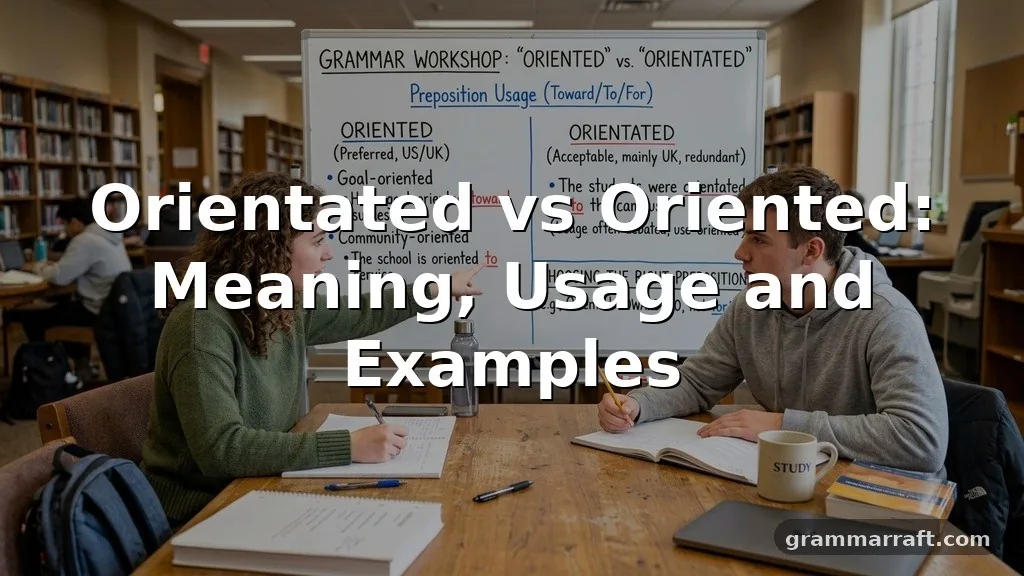
The difference between orientated vs oriented is usually a matter of regional preference, not meaning. Both words can describe someone who understands a situation, someone focused on a particular goal, or something positioned in a chosen direction.
Oriented is more common in American English and is also widely used in British English. Orientated is especially associated with British English, although many speakers elsewhere use it too.
Choosing between them depends mainly on your audience, the variety of English you are writing, and the expression you need. The examples below explain the grammar, pronunciation, history, regional patterns, and practical difference between the two forms.
Orientated vs Oriented: The Basic Difference
At the simplest level, orientated and oriented mean the same thing. Both come from the verb orient or orientate, and both can function as past-tense verbs, past participles, or adjectives.
For example, a new employee might be “oriented toward customer service” or “orientated toward customer service.” In either sentence, the employee’s attention or work is directed toward customer service.
The shorter form, oriented, is the more common choice in American English. It is also perfectly normal in British English, especially in business writing, technical communication, advertising, and international publications.
The longer form, orientated, is strongly associated with British English and appears frequently in British education, government, healthcare, and professional writing. It is not an error, a fake word, or an uneducated version of oriented.
| Form | Typical association | Example | Meaning |
|---|---|---|---|
| oriented | American English; also common internationally | customer-oriented service | Service focused on customers |
| orientated | British English and some other varieties | customer-orientated service | Service focused on customers |
| oriented | Direction or position | The map is oriented north. | The map is positioned in a particular direction |
| orientated | Direction or position | The map is orientated north. | The map is positioned in a particular direction |
There are some fixed expressions in which one form sounds much more natural to a particular audience. “Family-oriented” is extremely common, for instance, while “family-orientated” is also established, particularly in British writing.
The important point is that the difference is generally about dialect, style, and frequency. It is not usually a difference in definition.
What Does Oriented Mean?
Oriented can describe a physical direction. If a building is oriented toward the sea, its position or design faces the sea. If a photograph is oriented vertically, its height is greater than its width.
The word also has a mental or practical meaning. A person who is oriented understands where they are, what is happening, or what they need to do. In a hospital, staff may ask whether a patient is oriented to time, place, and person.
In that medical context, “oriented” has a more specific meaning than simply being familiar with a subject. It can indicate awareness of the date, location, identity, and situation. Medical professionals may use formal assessments rather than relying on the word alone.
Oriented also appears in compound adjectives. A company can be profit-oriented, a school can be student-oriented, and a project can be results-oriented.
- Goal-oriented: focused on achieving a defined result.
- Customer-oriented: designed around customer needs or expectations.
- Family-oriented: intended to suit or support family life.
- Community-oriented: focused on the interests of a local community.
- Detail-oriented: attentive to small points and potential errors.
These compounds can describe people, organisations, products, policies, or services. “She is detail-oriented” describes a person’s working style, while “a customer-oriented policy” describes the purpose of a policy.
The word can also mean “introduced to” or “given basic information about” something. A new employee may be oriented to the company’s procedures during the first week, although “oriented to” is less common in some contexts than “introduced to” or “trained in.”
In ordinary writing, oriented is straightforward and widely understood. It is often the safest choice for an international audience because readers in both American and British English recognise it immediately.
What Does Orientated Mean?
Orientated carries the same main meanings as oriented. It can refer to physical direction, awareness of a situation, or a person’s focus on a particular goal or group.
A British newspaper might describe a “technology-orientated business.” A university might offer a “student-orientated approach.” A designer might say that a building is “orientated toward natural light.” In each example, replacing orientated with oriented would not normally change the meaning.
Many British speakers prefer orientated because it follows a familiar verb pattern. Verbs such as activate, educate, and decorate form their past participles with -ated, so “orientated” may feel regular and complete.
That preference does not make the longer form more logical in every context. English contains many verbs with competing forms, and frequency often matters more than a single grammatical rule. Some speakers use “orientated” in formal writing but choose “oriented” in fixed compounds such as “oriented strand board” or “oriented programming.”
In British English, orientated is not limited to casual speech. It appears in edited publications and official documents. However, its frequency varies by field, and some British editors prefer the shorter form because it is more concise.
The form may sound unusual to American readers, but unfamiliarity is not the same as incorrectness. American dictionaries and style resources may list orientate while marking it as chiefly British or less common in American usage.
If your audience is mainly in the United Kingdom, Ireland, Australia, or another region where the longer form is established, orientated may sound entirely natural. If your audience is mainly in the United States, oriented will usually be the more familiar choice.
There is one practical caution. Do not assume that every speaker uses the same form consistently.
A British writer might use “orientated” in one sentence and “oriented” in a compound adjective. That variation reflects real usage rather than a failure to understand the difference.
Why Do British Speakers Say Orientated?
British speakers use orientated because it has a long-established place in British English. The form developed as a variant of oriented and became especially common in certain British registers, including formal education, public administration, and professional communication.
Language does not always reduce words to the shortest possible form. Speakers often create or preserve variants because they fit familiar patterns. “Orientated” resembles other verbs ending in -ate, and that pattern may help explain why it remains comfortable for many British users.
The word is also connected with orientation, meaning the act of determining position or becoming familiar with a place, situation, or subject. A new student attends an orientation session, and a person may become orientated with the relevant procedures.
That last phrase is less idiomatic than “become familiar with the procedures” in many forms of English. Still, it shows how the longer verb can be used in contexts involving introduction and adjustment rather than physical direction.
British usage is not perfectly uniform. Some British style guides, employers, and universities prefer oriented, particularly in compound adjectives such as “research-oriented” or “market-oriented.” Others use orientated consistently throughout their documents.
The choice can also reflect professional culture. A British health service document may use “patient-orientated care,” while a technology company operating in Britain may describe its product as “user-oriented.” Both forms can appear in the same national variety of English.
It is therefore misleading to say that the British always say orientated. The more accurate statement is that orientated is more characteristic of British English than American English, but oriented is common in Britain too.
Readers sometimes ask whether the longer form is pretentious. That judgment is usually based on personal preference. In a British context, “orientated” can be ordinary and unremarkable; in an American context, it may sound formal, regional, or unusual.
Is Orientated a Proper Word?
Yes. Orientated is a standard English word. It is used as the past tense and past participle of orientate, and it can also act as an adjective in phrases such as “community-orientated” or “politically orientated.”
Dictionaries may label it as British, chiefly British, or less common in American English. Such labels describe distribution and frequency. They do not mean that the word is grammatically invalid.
The same principle applies to many regional forms. A word can be standard in one variety of English and less familiar in another. “Whilst,” “amongst,” and “learnt” illustrate similar differences, although each has its own usage pattern.
The Cambridge Dictionary entry for orientate records the verb and gives the reader a useful indication of its meaning and regional use. Consulting a dictionary that identifies varieties of English is often more helpful than relying on a simple spell-checker.
Spell-checking software may underline orientated when its language setting is American English. That does not prove the word is wrong. It usually means the software expects the shorter form or has been configured for a different regional dictionary.
The word can be criticised in some organisations because employees have been told to use oriented for consistency. That is a style decision, not a universal rule. A company’s house style may prefer one spelling even when both forms are accepted in general English.
Writers should also distinguish orientated from unrelated-looking words such as oriental. The adjective “oriental” has a complicated history and is often avoided for people because it can sound dated or insensitive in modern English. That issue is separate from the ordinary verb orientate.
Use the form that suits your audience and follow any applicable style guide. If no style guide applies, oriented is the broadest international choice, while orientated is fully defensible in British-oriented writing.
Orientated vs Oriented in British and American English
Regional usage is the main reason people notice this pair. American English strongly favours oriented, while British English permits both forms and uses orientated more often than American English does.
Australian and New Zealand English also use both forms. The longer version may be familiar in formal or institutional writing, but local preferences vary by profession, publication, and individual speaker.
International English adds another layer. A multinational company may choose oriented because its documents are read across several countries. A local British organisation may retain orientated because it matches the language used by its staff and clients.
| Audience or setting | Likely preference | Recommended example |
|---|---|---|
| United States | Oriented | A results-oriented team |
| United Kingdom | Either; orientated is more characteristic | A results-orientated team |
| Australia or New Zealand | Either, depending on house style | A community-oriented project |
| International business | Usually oriented for broad familiarity | A customer-oriented platform |
| Academic or professional document | Follow the institution’s style guide | Use one form consistently |
Consistency matters more than choosing the supposedly superior form. Switching repeatedly between “oriented” and “orientated” can distract readers, particularly in a short report or marketing page.
That does not mean every appearance must be changed mechanically. Some established terms have a conventional spelling in a particular industry. If a product name, technical term, or organisation uses “oriented,” changing it to “orientated” could make the phrase less recognisable.
American writers should generally choose oriented unless they are quoting a British source or deliberately representing British usage. British writers can choose either, but they should consider the expectations of their readers.
The best decision is often simple: identify the publication’s main variety of English, then use the form that readers will encounter most naturally in that variety.
Grammar, Hyphens and Common Compounds
Both words can appear after a linking verb, before a noun, or as part of a compound adjective. For example, “The programme is student-oriented,” “a student-oriented programme,” and “the programme was oriented toward students” are all grammatical.
Compound adjectives placed before a noun are often hyphenated when the first element could otherwise be misunderstood. “Customer-oriented service” is easier to read than “customer oriented service.” After a noun, the hyphen is often unnecessary: “The service is customer oriented.”
British publications may write “customer-orientated service” and “the service is customer orientated.” American publications generally choose “customer-oriented” and “the service is customer oriented.”
Choosing the right preposition
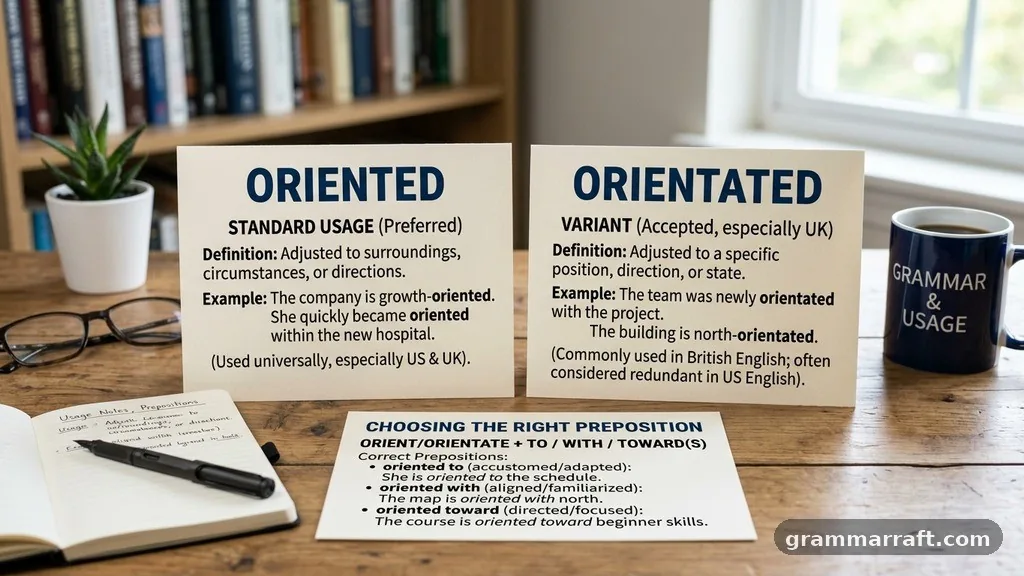
The preposition after oriented or orientated depends on the intended meaning. “Oriented toward” and “orientated towards” describe direction or focus, while “oriented to” and “orientated to” can describe a relationship with a subject, audience, or task.
- Oriented toward innovation: focused in the direction of innovation.
- Oriented to children: designed or adapted for children.
- Orientated towards public service: focused on public service.
- Oriented around a central theme: organised around that theme.
American English tends to favour “toward” without a final s, although “towards” is understood. British English commonly uses both “toward” and “towards,” with “towards” often sounding more natural.
Hyphenation in familiar expressions
Some compounds are so familiar that readers recognise them instantly. “Family-oriented,” “goal-oriented,” and “detail-oriented” are common examples. The corresponding British forms—“family-orientated,” “goal-orientated,” and “detail-orientated”—are also possible.
Do not hyphenate the verb in a normal sentence. Write “The course is oriented toward practice,” not “The course is oriented-toward practice.” Hyphens belong to compound modifiers, not to every multiword phrase containing the word.
If a phrase feels awkward, rewrite it. “A user-oriented design” may be clear, but “a design centred on users” can sound more natural and avoid a regional choice altogether.
Orientated vs Oriented: Examples in Real Sentences
Examples make the difference easier to see because the two forms usually fit the same grammatical positions. In the following sentences, the meaning remains stable even though the regional preference changes.
Describing a person
“Maya is highly goal-oriented and keeps a written plan for each project.” The adjective describes Maya’s focus and working habits.
“The new manager is strongly people-orientated.” This sentence is natural in British English and means that the manager pays close attention to people’s needs and relationships.
Describing an organisation
“The charity is community-oriented, with most of its programmes designed around local needs.” Here, the word describes the organisation’s central purpose.
“The clinic has become more patient-orientated since it introduced longer consultation times.” The longer form works naturally in a British context.
Describing direction
“The solar panels are oriented toward the south.” The sentence refers to physical positioning.
“The garden was orientated to receive morning sunlight.” This version has the same basic meaning, though some writers might prefer “positioned to receive morning sunlight.”
Describing introduction or awareness
“The training session oriented new volunteers to the organisation’s safety procedures.” In this active construction, oriented is the past tense of the verb.
“After a few minutes, the visitor became orientated and found the correct office.” Here, orientated describes someone who has gained an understanding of their surroundings.
Describing a product or service
“The software is designed for a mobile-oriented workflow.” The compound adjective identifies the intended focus of the software.
“The publication offers a research-orientated discussion of language change.” This wording would be unsurprising in British academic writing.
Sometimes the clearest sentence avoids both forms. Instead of “The policy is customer-oriented,” you could write “The policy focuses on customer needs.” Strong writing is not about using a particular suffix; it is about expressing the intended relationship clearly.
Pronunciation and Common Mistakes
Oriented is commonly pronounced with the stress on the first syllable: OR-ee-en-tid or, in some accents, a compressed version closer to OR-yen-tid. Pronunciation varies by region and by the speed of speech.
Orientated usually contains an additional syllable: OR-ee-en-tay-tid. Some speakers reduce the middle sounds, but the longer spelling generally signals a fuller pronunciation.
The two forms are often confused with oriental or with the noun orientation. They are related historically through the idea of direction, but they serve different grammatical roles. “Orientation” is a noun; “oriented” and “orientated” are verb forms or adjectives.
Another mistake is treating oriented as exclusively American. It is common in American English, but British speakers use it regularly too. Describing it as “the American spelling” oversimplifies actual usage.
The opposite mistake is calling orientated wrong because it sounds unfamiliar. A spell-check warning, a personal preference, or an American style guide does not establish a universal rule for every English variety.
Writers sometimes use both forms in the same paragraph without noticing. That inconsistency is not a serious grammar error, but it can make an article appear insufficiently edited.
- Check whether your document uses British or American English.
- Search for both forms if you suspect inconsistent usage.
- Keep the spelling consistent in repeated compounds.
- Check an industry or institutional style guide before editing formal work.
- Replace the phrase entirely if a simpler verb makes the meaning clearer.
Pronunciation is rarely a reason to reject either word. In speech, context usually makes the meaning clear. In writing, regional consistency and sentence clarity are the more important concerns.
Which Form Should You Use?
Use oriented if you are writing primarily for an American audience or for a broad international readership. It is concise, highly familiar, and accepted across major varieties of English.
Use orientated if you are writing in a British style and that form matches your organisation, publication, or intended audience. It is particularly suitable when the surrounding document already uses British vocabulary and spelling, such as “organised,” “labour,” or “programme.”
Do not switch forms simply because one seems more sophisticated. Neither version automatically makes a sentence more formal, precise, or professional. The surrounding wording matters more than the extra syllable.
| Your situation | Best practical choice | Reason |
|---|---|---|
| American school, workplace, or publication | Oriented | Matches common American usage |
| British publication with an established house style | Follow the house style | Both forms are accepted |
| Writing for mixed international readers | Usually oriented | Broadly familiar and concise |
| Quoting an organisation or preserving a formal name | Keep the original form | Names and quotations should not be silently altered |
Consistency should extend to related compounds. If a report says “customer-oriented” in one section, avoid writing “customer-orientated” in another unless you are discussing the variation itself.
SEO does not require choosing the form with the larger search volume. A useful page can naturally mention both spellings, explain the regional difference, and answer the reader’s question without repeating either keyword excessively.
For an academic assignment, follow the required style guide first. A university may request British English, American English, or a specific editorial system, and that instruction takes priority over general preference.
For ordinary writing, the safest rule is uncomplicated: choose the form your readers expect, use it consistently, and focus on the sentence’s actual meaning.
FAQ: Orientated vs Oriented
Is orientated a correct word?
Yes. Orientated is a correct standard word, particularly common in British English. It is the past tense or past participle of orientate, and it can also work as an adjective in phrases such as “community-orientated” and “goal-orientated.”
Do orientated and oriented mean exactly the same thing?
In most everyday and professional contexts, yes. Both can mean directed toward something, positioned in a particular direction, made familiar with a situation, or focused on a person, purpose, or result. The main distinction is regional usage and frequency, not basic meaning.
Why do some people dislike the word orientated?
Some readers are more familiar with oriented, especially if they use American English. They may therefore regard the longer form as unnecessary or awkward, but that reaction reflects preference rather than a general grammar rule. In British English, orientated has established and legitimate usage.
Should I write family-oriented or family-orientated?
Both are possible. Family-oriented is especially common in American English and is widely understood internationally, while family-orientated is common in British English. Choose the form that matches your audience and keep it consistent with similar compounds in the same document.
Is oriented better for formal writing?
Not automatically. Oriented is often the more concise and internationally familiar form, but orientated can be fully appropriate in formal British writing. Clear meaning, consistent regional style, and the expectations of the publication matter more than choosing one form as universally superior.
Conclusion
The practical answer to orientated vs oriented is that both forms are correct and usually share the same meaning. Oriented is more common in American English and broadly familiar worldwide, while orientated remains a normal choice in British English and related varieties.
Choose the form that suits your readers, follow any house style, and avoid switching between forms without a reason. Once you treat the difference as one of regional usage rather than right versus wrong, the choice becomes straightforward.




2 Comments